

Factory Automation Systems: How Manufacturers Are Reducing Manual Production Work
Manufacturing is changing rapidly as factories move away from processes that depend heavily on repetitive manual work toward connected, automated, and increasingly intelligent production environments. Factory automation systems are becoming an important part of this transformation because they allow manufacturers to automate repetitive tasks, monitor production processes, move materials, control machinery, inspect products, and coordinate operations with less manual intervention. The objective is not simply to replace human activity with machines. Instead, modern manufacturing automation is about creating production systems where technology handles repetitive and predictable activities while employees focus on supervision, problem-solving, quality decisions, engineering, and process improvement.
For many manufacturers, reducing manual production work has become a practical business requirement. Repetitive processes can consume valuable labor hours, create inconsistent results, increase the risk of workplace injuries, and make it difficult to maintain the same production speed throughout a shift. At the same time, manufacturers are facing skilled-worker shortages, rising operational costs, tighter delivery expectations, and growing demand for customized products. These pressures are encouraging companies to reconsider how much of their production process should depend on manual intervention.
Modern factory automation systems combine technologies such as programmable logic controllers, industrial robots, sensors, machine vision, automated material-handling equipment, manufacturing execution systems, Industrial IoT, software platforms, and increasingly artificial intelligence. Instead of automating one isolated task, manufacturers can connect multiple stages of production so that machines and software coordinate activities across the factory. This creates a more consistent flow of materials, information, and products.
The shift toward automation is also part of the broader Industry 4.0 movement. Today’s automated factories are increasingly connected, meaning equipment can generate data, systems can communicate with each other, and managers can monitor production performance in real time. Deloitte’s 2026 manufacturing outlook identifies automation, sensors, data analytics, cloud computing, smart manufacturing, and AI as important areas of continued investment in manufacturing. This demonstrates that automation is increasingly becoming part of a broader digital manufacturing strategy rather than a standalone equipment investment.
However, automation does not mean that people disappear from the factory. In many successful implementations, the role of employees changes. Instead of manually performing every repetitive movement, workers supervise automated processes, manage exceptions, analyze production information, maintain equipment, and make decisions that require experience and judgment. The result can be a more productive manufacturing environment where people and technology perform complementary roles.
What Are Factory Automation Systems?
Factory automation systems are integrated technologies used to control, monitor, and automate manufacturing processes with reduced manual intervention.
These systems can include hardware, software, sensors, controllers, robotics, machine vision, conveyors, automated storage systems, production software, and industrial communication networks.
A simple automation system may control one machine or production process. A more advanced system can connect multiple production lines, machines, quality processes, material-handling systems, and software platforms.
The purpose is to make production more consistent, efficient, measurable, and responsive.
Major Components of Factory Automation
| Automation Component | Manufacturing Role | Example Application |
|---|---|---|
| PLCs | Machine and process control | Automated production sequences |
| Sensors | Collect machine and process data | Temperature or pressure monitoring |
| Industrial robots | Automate physical tasks | Assembly and material handling |
| Machine vision | Automated inspection | Defect detection |
| HMIs | Operator interaction | Machine monitoring and control |
| Conveyors | Move materials and products | Production-line transportation |
| MES platforms | Manage production information | Production tracking |
| SCADA systems | Monitor industrial processes | Factory-wide process monitoring |
These components can work independently, but their price will increase whilst they’re related into a coordinated manufacturing machine.
Why Manufacturers Are Reducing Manual Production Work
Manual work will always have a place in manufacturing particularly in areas requiring judgment, craftsmanship, flexibility and complex problem-solving. However repetitive manual processes can create limitations.
Workers may need to repeat the same movement hundreds or thousands of times during a shift. This can contribute to fatigue and inconsistent performance. Manual inspection can also make it difficult to maintain quality standards across large production volumes.
Automation can address some of these challenges by performing repetitive processes with consistent timing and predefined parameters.
Another major factor is labor availability. Manufacturers, in regions are struggling to find and retain workers for certain production roles. Automation can help reduce the dependency on labor for tasks that are repetitive physically demanding or difficult to staff consistently.
The goal is therefore not simply “less human work.” It is less unnecessary manual work.

Manual Production vs. Automated Production
| Production Factor | Manual Production | Automated Production |
|---|---|---|
| Repetitive tasks | Worker-dependent | Machine-controlled |
| Cycle time | Can vary | More consistent |
| Quality | Dependent on operator | More repeatable |
| Data collection | Often manual | Automated |
| Material movement | Labor-intensive | Mechanized |
| Inspection | Often operator-based | Can use machine vision |
| Production monitoring | Periodic | Real-time capable |
| Workforce role | Task execution | Supervision and optimization |
The most effective manufacturing environments combine these approaches rather than treating them as opposites.
1. Automated Production Lines Are Reducing Repetitive Work
One of the clearest applications of manufacturing automation systems is the automated production line.
Automated production lines use a combination of machines, controllers, sensors, conveyors, robots, and software to move products through predefined manufacturing stages.
Instead of requiring an employee to manually transfer a component from one workstation to another, an automated system can move it through the production process.
This can reduce unnecessary movement and allow workers to focus on tasks that require more attention.
Automated production lines are particularly useful for high-volume manufacturing where processes are relatively standardized.
However, modern automation is becoming more flexible. Manufacturers are increasingly using programmable equipment that can support multiple product variants instead of relying exclusively on fixed production configurations.
2. PLCs Are Controlling Modern Factory Processes
Programmable Logic Controllers, commonly known as PLCs, remain one of the fundamental technologies behind industrial automation.
A PLC receives information from sensors and other devices and uses programmed logic to control machines and processes.
For example, a PLC can determine when a conveyor should start, when a machine should stop, or when a production component should move to the next stage.
PLCs are important because they provide the control layer connecting physical equipment with automation logic.
Although PLC technology has existed for decades, modern industrial control environments increasingly connect PLCs with higher-level manufacturing systems, industrial networks, data platforms, and analytics.
This creates a bridge between traditional industrial automation and connected manufacturing.
3. Sensors Are Making Automated Processes More Responsive
Sensors provide the information automation systems need to understand what is happening on the production floor.
Sensors can monitor temperature, pressure, vibration, position, speed, proximity, weight, flow, and other variables.
Without sensors, automated systems would have limited awareness of changing conditions.
For example, a proximity sensor can determine whether a component has reached the correct position. A temperature sensor can detect whether equipment is operating within an acceptable range. A pressure sensor can monitor process conditions.
Modern factories are increasingly connecting sensor data to analytics platforms, making sensors an important part of both automation and smart manufacturing.
4. Machine Vision Is Automating Quality Inspection
Quality inspection is another area where manufacturers are reducing manual work.
Traditionally, workers may inspect products visually to identify defects, missing components, incorrect assembly, surface problems, or other quality issues.
Machine vision systems use cameras, lighting, image-processing software, and increasingly AI-based computer vision to inspect products automatically.
This can allow manufacturers to inspect a larger percentage of production without relying entirely on manual inspection.
Machine vision can also provide consistent inspection criteria, although the effectiveness of the system depends heavily on application design, image quality, lighting, training data, and appropriate validation.
Automated Quality Control Applications
| Application | Manual Approach | Automation Approach |
|---|---|---|
| Surface inspection | Human visual inspection | Machine vision |
| Component presence | Operator checks | Camera-based detection |
| Product measurement | Manual measurement | Automated measurement |
| Assembly verification | Worker inspection | Vision-based verification |
| Label inspection | Manual checking | Automated recognition |
| Defect detection | Sampling or full inspection | Automated inspection |
Automation does not eliminate the need for quality professionals. Instead, it can allow quality teams to spend more time investigating root causes and improving processes rather than checking every individual product manually.
5. Automated Material Handling Is Changing Factory Logistics
Material movement is often overlooked when companies think about factory automation.
Workers may spend significant amounts of time transporting raw materials, components, work-in-progress products, and finished goods between different areas.
Automated material-handling systems can reduce this manual workload.
Conveyors, automated guided vehicles, autonomous mobile robots, automated storage and retrieval systems, and robotic palletizing systems can move materials through production and storage environments.
When these systems are connected to inventory and production software, material movement can become more coordinated.
Factory Material Automation Technologies
| Technology | Primary Function | Typical Use |
|---|---|---|
| Conveyors | Continuous movement | Production lines |
| AGVs | Guided material transport | Factory logistics |
| AMRs | Flexible material movement | Dynamic factory environments |
| Robotic palletizers | Product stacking | Warehouses and shipping |
| Automated storage systems | Storage and retrieval | Inventory management |
| Robotic handling | Component movement | Production cells |
This is especially valuable in larger facilities where material movement represents a significant amount of labor and production time.
6. Manufacturing Execution Systems Are Connecting Production
Manufacturing Execution Systems, or MES platforms, help manufacturers manage and monitor production activities.
An MES can connect production information from machines, operators, quality processes, materials, and production orders.
This provides greater visibility into what is happening on the factory floor.
Instead of relying on manual reports created at the end of a shift, manufacturers can use connected systems to track production status, downtime, quality information, and work orders more efficiently.
MES platforms can therefore act as an important link between shop-floor automation and broader business systems.
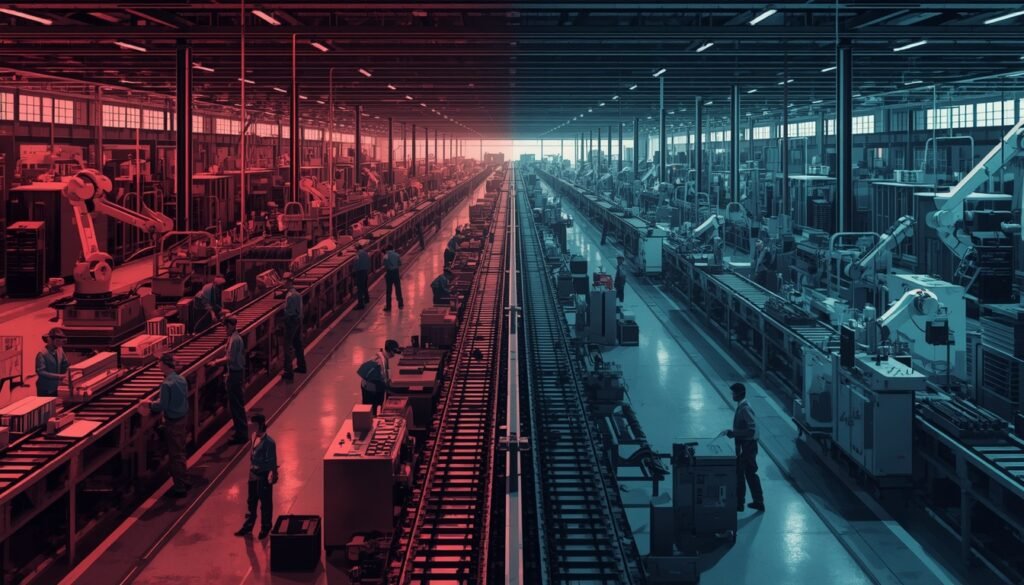
7. Robotics Is Automating Physical Production Tasks
Robotics remains an important part of factory automation systems, particularly for repetitive or physically demanding work.
Industrial robots can perform assembly, welding, painting, packaging, palletizing, machine tending, material handling, and other tasks.
Collaborative robots can also support applications where human workers and robots operate closer together, subject to appropriate safety requirements and risk assessments.
However, robotics is only one part of factory automation.
A robot may perform a task, but sensors, PLCs, machine vision, conveyors, safety systems, and manufacturing software may all be required for the complete automated process to function.
This is why manufacturers should evaluate automation at the system level rather than looking only at individual machines.
8. Automated Production Monitoring Is Improving Factory Visibility
Automation systems can generate large amounts of production information.
Manufacturers can monitor machine status, production counts, cycle times, downtime, quality measurements, energy consumption, and other operational indicators.
This data can be displayed through dashboards and manufacturing software, giving production managers greater visibility.
Real-time production monitoring can help teams identify bottlenecks sooner.
For example, if one production station begins operating more slowly than expected, the resulting impact on downstream operations can potentially be identified before the end of the production shift.
Production Metrics Supported by Automation
| Metric | What It Shows |
|---|---|
| Cycle time | Time required to complete a process |
| Downtime | Time equipment is unavailable |
| Throughput | Production output over a period |
| OEE | Overall equipment effectiveness |
| Scrap rate | Percentage of production discarded |
| First-pass yield | Products meeting requirements without rework |
| Machine utilization | How effectively equipment is being used |
The value of monitoring is not simply seeing the numbers. Manufacturers need to use those measurements to identify problems and improve processes.
9. Predictive Maintenance Is Becoming Part of Automation
Modern automation systems can also support maintenance.
Sensors connected to machines can collect information about temperature, vibration, operating hours, energy consumption, and other equipment conditions.
Analytics can then identify patterns that may indicate developing equipment problems.
This creates a connection between factory automation and predictive maintenance.
Instead of waiting for an automated machine to fail and stop production, manufacturers can potentially identify warning signs and schedule maintenance around production requirements.
This can help reduce unplanned downtime and improve equipment availability.
10. AI Is Adding Intelligence to Factory Automation
Artificial intelligence is becoming an increasingly important layer in modern manufacturing automation.
Traditional automation follows predefined rules. AI can help systems identify patterns, analyze large volumes of data, detect anomalies, and support more complex decisions.
AI can be used for automated quality inspection, predictive maintenance, production optimization, demand forecasting, process control, and anomaly detection.
NIST’s 2026 roadmap for AI and machine learning in smart manufacturing identifies industrial data analytics, advanced sensing, autonomous systems, digital twins, robotics, and optimization as important areas of development.
The important distinction is that AI should complement automation rather than automatically replace traditional control systems.
Safety-critical control functions may still require deterministic industrial control systems, while AI can provide analytics, prediction, optimization, and decision support.
How Factory Automation Improves Efficiency
The primary purpose of automation is to improve the overall performance of manufacturing operations.
Automation can reduce unnecessary manual movement, increase process consistency, provide faster production monitoring, and allow equipment to perform repetitive activities continuously.
It can also help manufacturers make better use of their workforce.
Instead of spending most of their time performing repetitive tasks, employees can supervise automated processes, troubleshoot equipment, analyze production information, and improve workflows.
Key Benefits of Factory Automation
| Benefit | How Automation Helps |
|---|---|
| Higher productivity | Automates repetitive production activities |
| Lower manual workload | Reduces unnecessary physical tasks |
| Better consistency | Maintains programmed process parameters |
| Improved quality | Supports automated inspection |
| Reduced downtime | Enables monitoring and predictive maintenance |
| Better safety | Reduces exposure to hazardous tasks |
| Faster decisions | Provides real-time production data |
| Greater scalability | Allows automation to expand with production |
The actual results depend on how well the automation system is designed and integrated with the production process.
Factory Automation and Workforce Transformation
One of the biggest misconceptions about manufacturing automation is that automation simply removes workers.
In reality, the workforce requirements often change.
Workers may move from manually operating machines toward monitoring automated systems, programming equipment, maintaining technology, analyzing data, managing quality, and solving production problems.
This creates demand for skills in automation engineering, robotics, PLC programming, industrial networking, data analysis, machine vision, cybersecurity, and equipment maintenance.
Manufacturers therefore need to treat workforce development as part of their automation strategy.
Automation without trained employees can create operational problems rather than solving them.
Challenges of Implementing Factory Automation Systems
Although automation can provide substantial benefits, implementation comes with challenges.
Legacy machinery is one of the most common problems. Older machines may not have modern communication interfaces or sensors.
Integration can also be complex because factories often use equipment and software from multiple vendors.
Cybersecurity is another important consideration. As more machines connect to networks, the operational technology environment becomes more interconnected.
Cost is also a factor. A complete automation project may require investment in equipment, software, engineering, integration, safety systems, training, and maintenance.
Common Factory Automation Challenges
| Challenge | Why It Matters | Potential Response |
|---|---|---|
| Legacy equipment | Difficult to connect | Retrofit sensors and gateways |
| High investment | Longer payback | Prioritize high-value use cases |
| Integration complexity | Systems may not communicate | Use compatible interfaces |
| Skills gap | Limited technical expertise | Train and upskill workers |
| Cybersecurity | More connected assets | Strengthen OT security |
| Maintenance | Automated systems need support | Build maintenance capabilities |
| Scalability | Pilot may not work elsewhere | Design for future expansion |
Manufacturers should therefore avoid treating automation as a simple equipment purchase.
How Manufacturers Can Start With Factory Automation
The best starting point is a clearly defined production problem.
Manufacturers should identify where manual work is consuming significant time, where quality varies, where workers face repetitive or hazardous tasks, or where production visibility is poor.
Once a suitable process is identified, manufacturers can establish a baseline.
For example, they can measure cycle time, labor hours, error rates, downtime, output, and quality before automation.
After implementing an automated solution, those same measurements can be used to determine whether the investment delivered meaningful improvement.
Factory Automation Implementation Roadmap
| Stage | Objective | Key Action |
|---|---|---|
| 1 | Identify | Find a repetitive or inefficient process |
| 2 | Measure | Establish the current performance baseline |
| 3 | Evaluate | Select the appropriate automation technology |
| 4 | Pilot | Implement automation on a controlled scale |
| 5 | Validate | Measure productivity, quality and cost changes |
| 6 | Optimize | Improve the automated workflow |
| 7 | Scale | Expand successful automation |
This approach helps manufacturers avoid investing in technology simply because it is popular.
What Is the Future of Factory Automation?
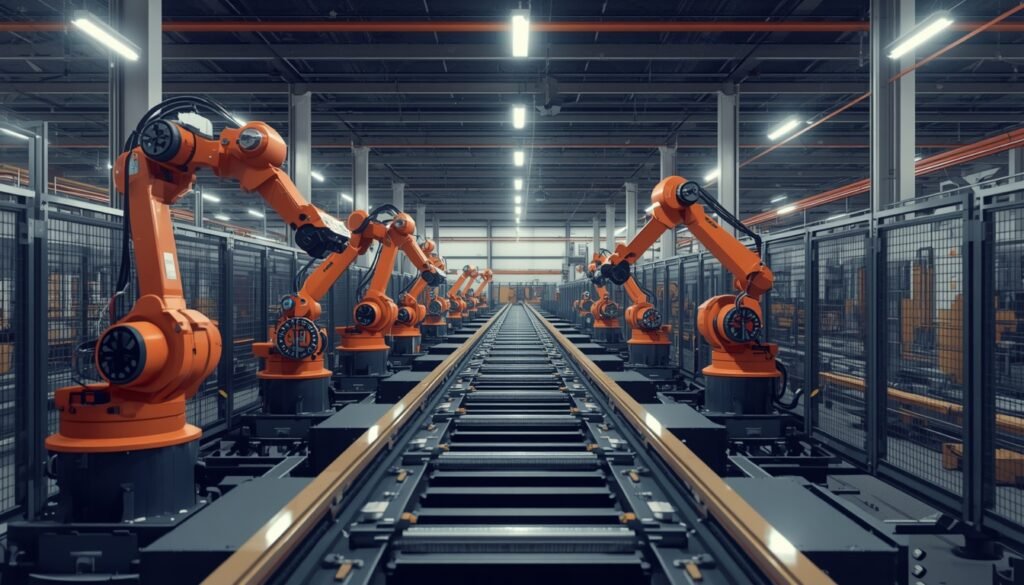
The future of factory automation systems will involve increasing integration between machines, software, robotics, AI, sensors, and people.
Traditional automation will continue to provide reliable control, while AI and analytics will add more advanced decision support.
Robotics will become more flexible, machine vision will become more capable, and edge computing will allow more processing to occur closer to machines.
Connected production systems will also make it easier for manufacturers to coordinate production, maintenance, inventory, and quality activities.
The emergence of physical AI could further change industrial automation by allowing machines to perceive their environments and respond to physical conditions.
However, the future factory will not be completely autonomous in every application. Human workers will continue to play important roles in engineering, supervision, decision-making, maintenance, safety, and continuous improvement.
The goal will increasingly be human-centered automation, where technology removes unnecessary manual work while allowing people to focus on activities that require experience and judgment.
Conclusion
Factory automation systems are changing the way manufacturers approach production by reducing repetitive manual work, improving consistency, increasing production visibility, and enabling more connected operations.
PLCs, sensors, robotics, machine vision, conveyors, MES platforms, automated material-handling systems, Industrial IoT, predictive maintenance, and AI are increasingly working together to create modern automated manufacturing environments.
The most important benefit of automation is not simply doing more work with fewer manual steps. It is creating a production system that is more consistent, measurable, efficient, and responsive.
Manufacturers can use automation to reduce unnecessary physical work, improve workplace safety, strengthen quality control, reduce downtime, and help employees focus on higher-value activities.
However, successful automation requires careful planning. Companies need to consider legacy equipment, integration, cybersecurity, workforce skills, maintenance, safety, and long-term scalability.
The manufacturers that gain the most from automation will be those that start with real production problems and choose technology based on measurable outcomes.
As connected technologies continue to develop, factory automation will move beyond individual machines toward intelligent production ecosystems. The future factory will increasingly combine automation, data, robotics, AI, and human expertise to create more efficient and flexible manufacturing operations.

Jimmy Simmons
Jimmy Simmons contributes insights and analysis across banking, financial services, fintech, markets and emerging technology.