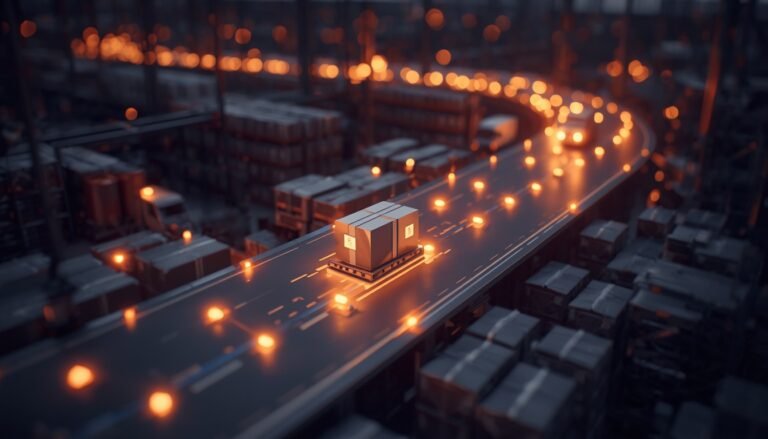

Smart Logistics in Manufacturing: How Technology Improves Inventory and Delivery
Manufacturing does not stop at the production line. Once raw materials enter a factory they need to be received, stored moved to the production area tracked throughout the manufacturing process and eventually delivered as finished products. Every movement matters. A missing component can delay production. Inaccurate inventory information can create purchasing. A delayed shipment can affect customer relationships. This is why logistics has become a more strategic part of modern manufacturing. Smart logistics in manufacturing is helping companies connect inventory, warehouses, transportation, production and delivery through technology so that materials and products can move with visibility and less manual intervention.
Traditional manufacturing logistics often depended on inventory checks, spreadsheets, phone calls, paper-based records and periodic updates from logistics providers. These methods can work in less complex operations but they become increasingly difficult as manufacturers manage multiple suppliers, warehouses, production facilities, product variations and distribution channels. A company may technically have inventory but still be unable to locate the required component. A shipment may be delayed without the production team knowing until the expected delivery date passes. These gaps can create pressure throughout the operation.
Modern logistics technology is changing this situation. Internet of Things sensors, warehouse management systems, automated material-handling equipment, GPS tracking, cloud platforms, artificial intelligence, robotics, analytics, and connected enterprise systems can provide manufacturers with a much clearer view of how materials and products move. Instead of treating inventory and transportation as separate activities, companies can increasingly connect them with production and order information.
The idea behind smart logistics is not simply to automate every logistics task. It is to make logistics more connected, visible, responsive, and data-driven. Technology can help teams know what inventory is available, where it is located, when materials are expected to arrive, which orders are being processed, and whether a delivery is likely to reach the customer on time.
This is particularly important because manufacturing supply chains are rarely static. Demand changes suppliers face disruptions transportation schedules shift and production requirements can change quickly. A logistics system that depends entirely on updates may struggle to keep pace. A connected logistics environment can provide information faster and allow teams to respond before small issues become major operational problems.
For manufacturers the result can be inventory control, more efficient warehouse operations, improved production coordination and greater delivery reliability.
What Is Smart Logistics in Manufacturing?
Smart logistics in manufacturing refers to the use of connected technologies, automation, data, and intelligent systems to manage the movement and storage of materials, components, work-in-progress products, and finished goods.
It connects logistics activities with manufacturing operations so that companies can manage the flow of physical products alongside the flow of information.
Smart logistics can involve:
- Real-time inventory tracking
- Automated warehouse systems
- IoT-enabled monitoring
- GPS and shipment tracking
- Automated material handling
- Warehouse management software
- Transportation management systems
- AI-powered analytics
- Robotics and autonomous mobile robots
- Cloud-based logistics platforms
The objective is to improve the efficiency and visibility of the entire material flow.
Key Areas of Smart Manufacturing Logistics
| Logistics Area | Technology Used | Main Purpose |
|---|---|---|
| Inventory | RFID, IoT, WMS | Track stock and location |
| Warehousing | Automation, robotics | Improve storage and movement |
| Material handling | AMRs, AGVs, conveyors | Reduce manual transportation |
| Transportation | GPS, telematics | Monitor shipments |
| Delivery | TMS, tracking platforms | Improve delivery visibility |
| Planning | AI, analytics | Improve forecasting and scheduling |
| Communication | Cloud platforms | Connect logistics teams |
These technologies do not necessarily need to be implemented all at once. Manufacturers can introduce them according to their operational priorities.

Why Smart Logistics Is Becoming Important for Manufacturers
Manufacturing operations are becoming more complex.
A single manufacturer may additionally source materials from several suppliers, preserve inventory throughout more than one facilities, function extraordinary production strains, and deliver finished merchandise to clients in different areas.
As this complexity increases, manual logistics processes become harder to manage.
Inventory is a good example.
If a warehouse employee manually updates inventory after receiving or moving every component, even a small delay or error can make the system inaccurate. Once inventory information becomes unreliable, procurement and production planning can also be affected.
Smart logistics addresses this by creating more automated flows of information.
When a material is received, scanned, moved, consumed, or shipped, the event can potentially be recorded automatically.
This creates a more accurate picture of inventory movement.
1. Real-Time Inventory Tracking Is Changing Warehouse Management
One of the important benefits of smart logistics is better inventory visibility.
Traditional inventory management often relies on physical counts and manual updates.
Modern systems can track inventory continuously through technologies such, as RFID, barcode scanning, IoT sensors, warehouse management systems and connected enterprise software.
This means manufacturers can know not how much stock they have but also where inventory is located.
For example a manufacturing company may have thousands of components stored across warehouse areas.
A connected inventory system can help identify the location and status of components of requiring employees to search manually.
This saves time and improves production planning.
Inventory Visibility Comparison
| Traditional Inventory | Smart Inventory |
|---|---|
| Manual counting | Automated tracking |
| Periodic updates | Near real-time information |
| Spreadsheet-based records | Connected inventory systems |
| Limited location visibility | Detailed location tracking |
| Manual reconciliation | Automated data capture |
| Reactive replenishment | Data-driven planning |
Better inventory visibility also helps manufacturers avoid two common problems: stockouts and excess inventory.
2. IoT Is Making Logistics More Connected
The Internet of Things is becoming more and more important in manufacturing logistics.
IoT sensors can collect information about materials, equipment, vehicles, storage conditions and shipments.
For example sensors can monitor temperature- materials during transportation. Location-enabled devices can track shipments as they move between facilities. Connected warehouse equipment can provide information about utilization and operating conditions.
The benefit is that logistics teams can access information without depending entirely on manual updates.
This can be particularly useful when materials move through multiple stages or locations.
Instead of asking where a shipment is, a connected logistics system can provide its current status and estimated arrival information.
3. Warehouse Automation Is Reducing Manual Material Movement
Warehouses can involve a significant amount of repetitive physical work.
Employees may need to receive goods, move materials, pick components, organize inventory, prepare orders, and load shipments.
Warehouse automation can reduce some of this workload.
Automated storage and retrieval systems, conveyors, automated guided vehicles, autonomous mobile robots, robotic picking systems, and automated sorting equipment can help move materials through warehouses.
The goal is not necessarily to automate every warehouse activity. Instead, manufacturers can identify tasks where automation can provide measurable improvements in speed, accuracy, safety, or labor efficiency.
Warehouse Automation Technologies
| Technology | Application | Benefit |
|---|---|---|
| Automated storage systems | Store and retrieve materials | Better space utilization |
| Conveyors | Move products | Faster material flow |
| AGVs | Transport materials | Automated movement |
| AMRs | Flexible warehouse transport | Adaptable operations |
| Robotic picking | Pick components | Faster order preparation |
| Automated sorting | Organize products | Improved throughput |
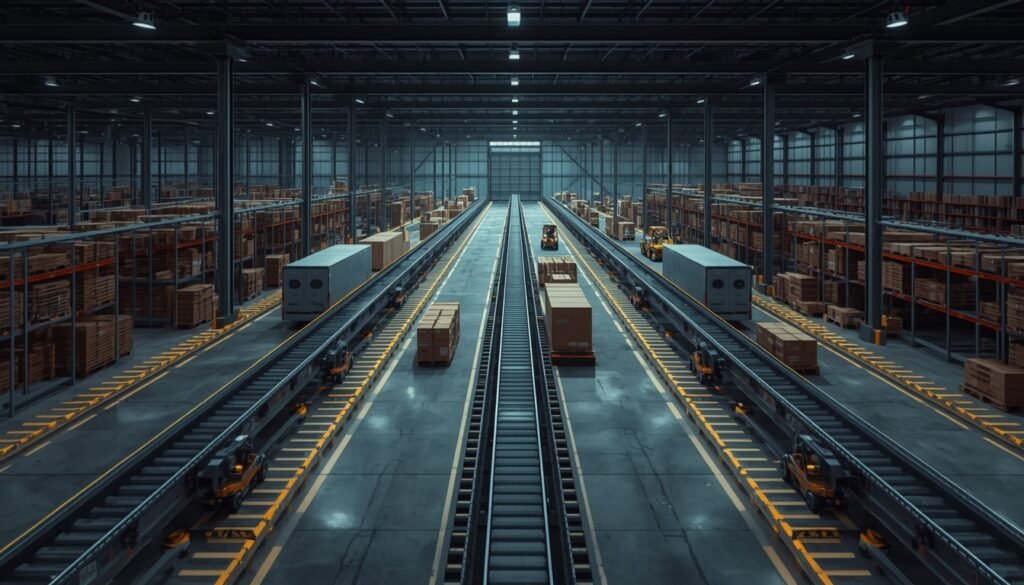
When warehouse automation is connected to inventory and production systems, material movement can become more coordinated.
4. Smart Logistics Helps Connect Warehouses With Production
A warehouse does not operate independently from a manufacturing plant.
Production teams need materials at specific times and quantities.
If components arrive too early, they may occupy storage space. If they arrive too late, production can stop.
Smart logistics helps connect warehouse activity with production schedules.
For example a production planning system might find out that a certain part is needed for an order. The logistics system can then help make sure that part is ready and sent to the place in the factory.
This creates a more synchronized relationship between logistics and manufacturing.
The objective is to deliver the right material, to the right location, at the right time.
5. AI Is Improving Logistics Planning
Artificial intelligence is being used more and more to look at logistics data and help with planning.
AI tools can look at information about stock, moving goods how suppliers perform, how much people want, when things are made and how deliveries have gone in the past.
This can help manufacturers identify patterns and potential problems.
For example, an AI-powered system may identify that demand for a particular component regularly increases during certain periods. It can also identify suppliers or transportation routes that frequently experience delays.
This can help logistics teams make more informed decisions.
However, AI should not be viewed as a replacement for logistics expertise. Its effectiveness depends on accurate data and the quality of the processes surrounding it.
6. Predictive Inventory Management Can Reduce Waste
Traditional inventory planning often relies heavily on historical demand and fixed replenishment rules.
Predictive inventory management takes a more dynamic approach.
Data and AI can look at how much people want how long it takes to get parts from suppliers when things are made what is already in stock and other things to guess what will be needed next.
This can help companies not have much extra stock while still keeping enough for emergencies.
For example if a company expects more people to want a product the logistics team can get the stock ready before it is really needed.
This is when smart logistics, for managing inventory becomes very useful.
Inventory Challenges and Smart Solutions
| Inventory Challenge | Smart Logistics Response |
|---|---|
| Stockouts | Real-time inventory monitoring |
| Excess stock | Demand analytics |
| Unknown inventory location | RFID and digital tracking |
| Manual counting | Automated data capture |
| Slow replenishment | Automated alerts |
| Poor demand visibility | Predictive analytics |
The goal is not to maintain the highest possible inventory level. It is to maintain the right inventory for the business.
7. GPS Tracking Is Improving Delivery Visibility
Once finished products leave the factory, transportation visibility becomes important.
GPS tracking and connected transportation platforms allow manufacturers to monitor shipments while they are in transit.
This can provide information about current location, estimated arrival time, route changes, and delivery status.
For customer-facing businesses, this information can also improve communication.
Instead of telling a customer that an order is “in transit,” a manufacturer may be able to provide a more accurate delivery estimate.
This creates greater transparency between manufacturers, logistics providers, and customers.
8. Transportation Management Systems Are Connecting Deliveries
Transportation Management Systems, or TMS platforms, help companies manage transportation activities.
A TMS can support carrier management, shipment planning, route optimization, tracking, freight management, and delivery analysis.
When connected to ERP, warehouse, and production systems, transportation planning can become more coordinated.
For example, if production is delayed, transportation plans can potentially be adjusted before a shipment is dispatched.
This reduces the disconnect between what happens inside the factory and what happens outside it.
Smart Logistics and Delivery Performance
Delivery performance is one of the most visible outcomes of logistics efficiency.
Customers generally care about whether their order arrives when promised and in the expected condition.
Manufacturers therefore need to coordinate production, inventory, warehousing, transportation, and customer requirements.
Smart logistics can support this coordination by providing better information at each stage.
Delivery Metrics Manufacturers Can Track
| Metric | Purpose |
|---|---|
| On-time delivery | Measures delivery reliability |
| Order cycle time | Measures order fulfillment speed |
| Transit time | Measures transportation efficiency |
| Delivery accuracy | Tracks correct order fulfillment |
| Freight cost | Measures transportation spending |
| Perfect order rate | Evaluates overall fulfillment quality |
Tracking these metrics helps manufacturers understand where logistics performance is strong and where improvements are required.
9. Digital Twins Can Improve Logistics Planning
Digital twins are increasingly being explored beyond production environments.
Manufacturers can use digital representations of warehouses, logistics networks, production systems, or supply chain processes to evaluate different scenarios.
For example, a manufacturer could simulate changes to warehouse layouts, inventory policies, transportation routes, or production schedules.
This can help teams understand potential outcomes before making physical changes.
Digital twins can therefore become useful tools for logistics planning and optimization.
10. Connected Logistics Can Improve Supply Chain Resilience
Supply chains rarely operate without disruptions.
Supplier delays, transportation problems, unexpected demand, natural events, and geopolitical changes can affect manufacturing operations.
Smart logistics does not eliminate these risks.
What it can do is improve visibility and response speed.
When companies know where their inventory is, what shipments are delayed, which suppliers are affected, and what production requirements are approaching, they can make decisions faster.
This can improve supply chain resilience.
Smart Logistics and Resilience
- Earlier identification of disruptions
- Better inventory visibility
- Faster transportation decisions
- Improved supplier coordination
- More accurate production planning
The ability to respond quickly can be just as important as the ability to predict a disruption.
How Smart Logistics Improves Manufacturing Efficiency
Smart logistics can affect more than warehouse and transportation performance.
When logistics processes become more connected, manufacturing teams can spend less time searching for materials, manually updating records, or following up on shipment status.
This can improve overall operational efficiency.
For example, if a production employee needs a specific component, the system can provide information about its inventory location. If a shipment is delayed, the production planning team can receive an alert rather than discovering the problem later.
Small improvements like these can add up across a large manufacturing operation.
Key Efficiency Benefits
| Area | Impact of Smart Logistics |
|---|---|
| Inventory | Better accuracy and control |
| Warehousing | Faster material movement |
| Production | Better material availability |
| Transportation | Improved shipment visibility |
| Delivery | More predictable fulfillment |
| Labor | Less repetitive manual tracking |
| Planning | Better data-driven decisions |
Challenges of Implementing Smart Logistics
Smart logistics can deliver significant benefits, but implementation is not always simple.
Many manufacturers operate with a mixture of old and new technology.
A warehouse may use modern automation while the production system still depends on legacy software. Suppliers may use different data formats. Logistics providers may have different tracking systems.
Connecting these systems can become one of the biggest challenges.
Data quality is another issue. If inventory records are inaccurate, a sophisticated analytics platform will still produce unreliable results.
Cybersecurity also becomes more important as logistics systems become more connected.
Common Smart Logistics Challenges
| Challenge | Potential Problem |
|---|---|
| Legacy systems | Difficult integration |
| Data silos | Incomplete visibility |
| Poor data quality | Incorrect decisions |
| High implementation cost | Longer ROI period |
| Skills gap | Difficult system management |
| Cybersecurity | Increased digital exposure |
| Supplier connectivity | Limited external data |
Manufacturers should therefore approach smart logistics as a long-term transformation rather than a single technology purchase.
How Manufacturers Can Start With Smart Logistics
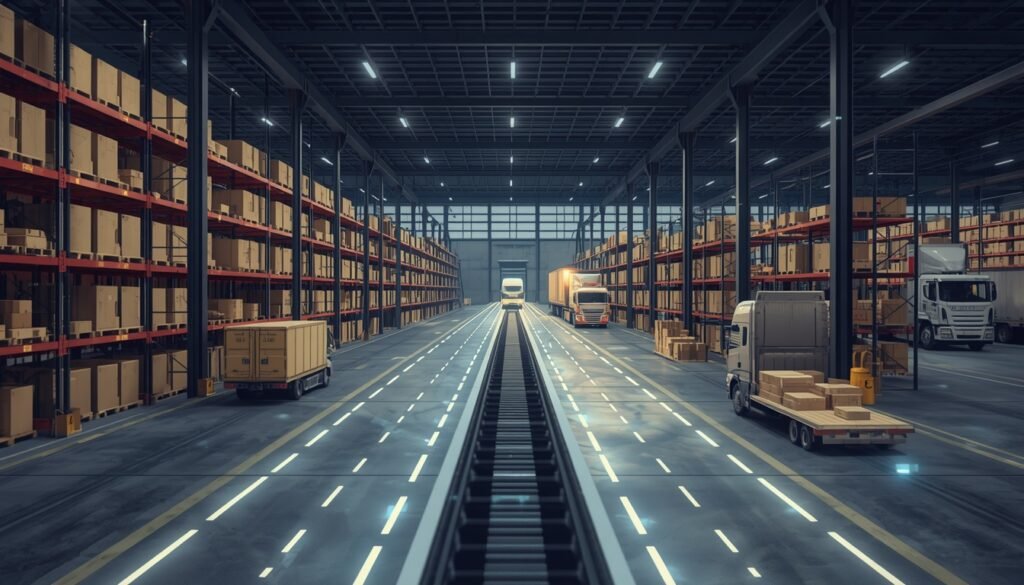
Companies do not need to automate their entire logistics network immediately.
A better approach is to identify one area where manual work or poor visibility is creating a measurable problem.
For some manufacturers, that may be inventory tracking.
For others, it may be warehouse movement or transportation visibility.
Once the problem is identified, the manufacturer can establish a baseline and select technology based on the desired outcome.
Practical Smart Logistics Roadmap
| Step | Focus |
|---|---|
| 1 | Identify logistics bottlenecks |
| 2 | Measure current performance |
| 3 | Select a high-value use case |
| 4 | Connect relevant data sources |
| 5 | Implement a controlled pilot |
| 6 | Measure the results |
| 7 | Improve the process |
| 8 | Scale successful solutions |
This approach allows manufacturers to demonstrate value before making larger investments.
The Future of Smart Logistics in Manufacturing
The future of smart logistics in manufacturing will involve greater integration between physical logistics systems and digital intelligence.
Warehouses will become more automated. Inventory information will become more real-time. Transportation systems will provide better visibility. AI will support planning and forecasting. Autonomous mobile robots will move materials through factories and warehouses. Digital twins will help companies simulate logistics decisions.
The biggest shift, however, will be the move from reactive logistics to proactive logistics.
Instead of discovering that inventory is low after a production problem occurs, systems will increasingly identify potential shortages earlier.
Instead of finding out that a shipment is late when the expected delivery date passes, manufacturers will receive alerts when the shipment begins moving outside its expected schedule.
Instead of manually checking every logistics activity, teams will increasingly focus on exceptions that require attention.
This will make logistics less about tracking individual events and more about managing the overall flow of materials and information.
Conclusion
Smart logistics in manufacturing is changing how companies manage inventory, warehouses, transportation, and delivery.
Technologies such as IoT, RFID, warehouse automation, robotics, GPS tracking, cloud platforms, AI, analytics, and transportation management systems are helping manufacturers create more connected logistics operations.
The biggest benefit is not simply automation. It is visibility.
When manufacturers know where materials are, how much inventory is available, when shipments are expected, and what production requires, they can make better decisions.
Smart logistics can reduce unnecessary manual work, improve inventory accuracy, increase warehouse efficiency, strengthen delivery visibility, and help manufacturers respond faster when supply chain conditions change.
At the same time, successful implementation requires careful planning. Manufacturers need to address legacy systems, data quality, integration, cybersecurity, workforce skills, and the overall cost of transformation.
The most practical approach is to begin with a clear logistics problem, measure its impact, introduce the right technology, and scale the solution once it demonstrates measurable value.
As manufacturing becomes increasingly connected, logistics will become more than the movement of materials. It will become a data-driven operational function that connects inventory, production, warehouses, transportation, and customers.
Manufacturers that build this level of connectivity will be better positioned to control inventory, improve delivery performance, respond to disruptions, and operate more efficiently in an increasingly complex supply chain environment.
Frequently Asked Questions
1. What is smart logistics in manufacturing?
Smart logistics in manufacturing uses connected technologies, automation, data, and intelligent systems to manage the movement, storage, tracking, and delivery of materials and products. It can connect inventory, warehouses, production, transportation, and delivery operations.
2. How does smart logistics improve inventory management?
Smart logistics can provide real-time information about inventory levels, locations, movement, and replenishment requirements. Technologies such as RFID, IoT, warehouse management systems, and analytics can help manufacturers improve inventory accuracy and reduce stockouts or excess inventory.
3. What technologies are used in smart manufacturing logistics?
Common technologies include IoT sensors, RFID, warehouse management systems, transportation management systems, GPS tracking, robotics, automated storage systems, autonomous mobile robots, cloud platforms, AI, and supply chain analytics.
4. How does smart logistics improve delivery?
Smart logistics can provide real-time shipment tracking, estimated arrival times, route information, and delivery alerts. This helps manufacturers identify transportation delays earlier and improve delivery planning and customer communication.
5. Can AI improve manufacturing logistics?
Yes. AI can analyze inventory, demand, supplier, production, and transportation data to identify patterns, forecast requirements, detect potential disruptions, and support logistics planning. The quality of AI-driven results depends on the accuracy and completeness of the underlying data.
6. What is the role of IoT in manufacturing logistics?
IoT allows manufacturers to collect information from connected sensors, equipment, vehicles, and materials. This can provide better visibility into inventory movement, shipment conditions, equipment status, and logistics operations.

Jimmy Simmons
Jimmy Simmons contributes insights and analysis across banking, financial services, fintech, markets and emerging technology.