
Industrial IoT in Manufacturing: How Connected Machines Improve Factory Performance
A cutting-edge manufacturing facility generates a quantity of data every day. Machines run for hours production lines complete hundreds of operations sensors measure equipment conditions workers report processes warehouses move materials and quality teams inspect products.. For many producers much of this data remains scattered across individual machines, systems, spreadsheets and manual reports.
This is changing as factories become more connected.
Industrial IoT in manufacturing is helping companies connect machines, sensors, production systems, and industrial equipment so that operational data can be collected, analyzed, and used for better decisions. Instead of treating every machine as an isolated asset, manufacturers can create a connected environment where equipment continuously communicates information about its performance and condition.
The idea behind Industrial IoT or IIoT is not just to place sensors on machines. The bigger goal is to achieve visibility across manufacturing operations.
A connected system can provide data about temperature, vibration, stress, speed, energy usage, production output, operating conditions and equipment status. When this data is combined with production software and analytics manufacturers gain a view of what is happening on the factory floor.
This can change how factories approach maintenance, production planning, quality management, energy consumption, inventory coordination, and operational efficiency.
For example, instead of discovering that a machine stopped after production was interrupted, a connected system may identify unusual equipment behavior earlier. Instead of waiting for an end-of-shift report to understand production performance, managers can access more current information. Instead of estimating machine utilization, production teams can use actual operational data.
This makes Industrial IoT in manufacturing an important technology for smart factories.
However, connectivity alone does not improve factory performance. The real value comes from collecting useful data, connecting it to the right systems, analyzing it effectively, and turning those insights into practical operational decisions.
As manufacturers look for ways to improve productivity while controlling costs and reducing unplanned downtime, connected machines are becoming an increasingly important part of the manufacturing technology landscape.
What Is Industrial IoT in Manufacturing?
Industrial IoT in manufacturing refers to the use of sensors, machines, devices, industrial networks, software and analytics to collect and exchange data across manufacturing operations.
It extends the concept of the Internet of Things into environments.
A connected manufacturing machine may continuously collect information about its operating condition. Send that information to an edge device, manufacturing platform, cloud system or analytics application.
The data can then be used to monitor equipment identify abnormalities improve production visibility and support decision-making.
Common IIoT Components
| Component | Role in Manufacturing |
|---|---|
| Sensors | Collect machine and process data |
| Connected machines | Generate operational information |
| Industrial networks | Transfer data between systems |
| Edge devices | Process data close to machines |
| Cloud platforms | Store and analyze information |
| Analytics | Turn data into insights |
| AI and ML | Identify patterns and anomalies |
| Dashboards | Present operational information |
The exact architecture varies between factories, depending on equipment, production processes, connectivity requirements, and business objectives.
How Industrial IoT Works in a Factory
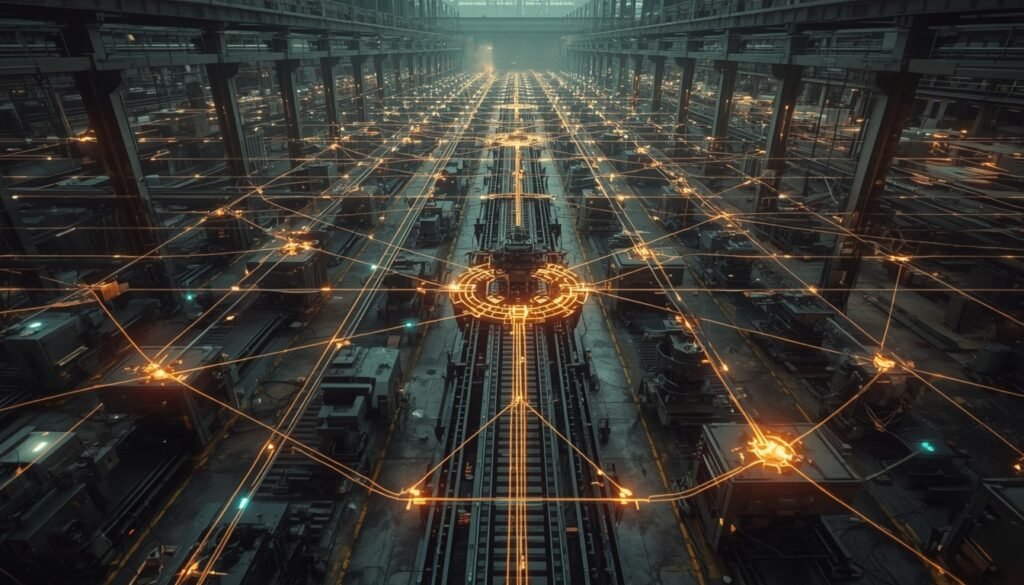
An IIoT environment generally follows a simple process.
Machines and sensors first collect operational data.
The data is then transmitted through industrial networks or gateways.
Some of the data may be processed on edge devices right where it is collected. Other data might go to systems or cloud platforms.
Analytics software can look at the data to find patterns send alerts or give reports to teams that manage production and maintenance.
The process can be summarized as:
Sense → Connect → Collect → Analyze → Act
The final stage is the most important.
For example a vibration sensor might pick up movement in a machine.. The real value comes when this information helps a maintenance team check the machine before it breaks down completely.
That kind of action prevents downtime and keeps operations running smoothly.
Why Connected Machines Matter for Modern Factories
Traditional production environments frequently comprise machines from extraordinary generations.
Some system may also have advanced connectivity, while older machines may additionally generate limited digital data.
This creates visibility gaps.
A machine may continue operating for years without providing detailed information about its condition or performance.
Industrial IoT can help bridge some of these gaps by adding sensors, gateways, or connectivity technologies to existing equipment.
This can allow manufacturers to collect information from both modern and legacy machinery.
Connected machines can provide manufacturers with a more current view of factory operations.
Instead of asking workers to manually inspect or record every machine condition, automated systems can collect information continuously.
This can save time while creating a more consistent source of operational data.
1. IIoT Improves Machine Monitoring
One of the most not unusual applications of Industrial IoT is device monitoring.
Sensors can monitor conditions which includes temperature, vibration, pressure, pace, modern, and strength intake.
When those values alternate notably, the system can generate an alert or offer records for in addition research.
Continuous tracking is particularly treasured for machines that perform for lengthy periods or perform crucial manufacturing sports.
Machine Conditions Commonly Monitored
| Machine Data | Potential Insight |
|---|---|
| Temperature | Overheating or excessive friction |
| Vibration | Mechanical abnormalities |
| Pressure | Process or equipment issues |
| Electrical current | Motor or load changes |
| Speed | Performance variation |
| Energy use | Efficiency changes |
| Operating hours | Maintenance planning |
The appropriate data depends on the type of machine and the failure conditions manufacturers want to identify.
2. Industrial IoT Supports Predictive Maintenance
Predictive maintenance is one of the valuable applications of connected machine data. Traditional reactive maintenance waits for equipment to fail.
Preventive maintenance performs service at predefined intervals. Predictive maintenance uses equipment condition data to identify problems before failure.
IIoT sensors provide the information needed for this approach.
For example a connected motor may show increasing vibration. The change may indicate developing problems.
Maintenance teams can investigate the issue and schedule repairs before the machine experiences a major breakdown.
This can help manufacturers reduce downtime and improve equipment reliability.
3. IIoT Helps Reduce Unplanned Downtime
Unexpected machine downtime can disrupt production schedules, delay orders, and increase maintenance costs.
Connected machines can provide early indications of abnormal operating conditions.
This gives manufacturers an opportunity to respond before a problem becomes a full production stoppage.
However, IIoT does not guarantee that machines will never fail.
Its value lies in providing better visibility and earlier information.
How IIoT Can Influence Downtime
| Traditional Situation | IIoT-Enabled Approach |
|---|---|
| Failure discovered after stoppage | Condition monitored continuously |
| Manual inspections | Automated data collection |
| Emergency repair | Earlier intervention |
| Limited machine visibility | Real-time condition information |
| Reactive response | More proactive maintenance |
This can make maintenance planning more predictable.
4. Industrial IoT Improves Production Visibility
Production managers need to know what is happening on the factory floor.
They need visibility into machine status, production output, downtime, cycle times, and production progress.
Without connected systems, this information may come from manual reports. Manual reporting can introduce delays and inconsistencies.
IIoT allows machines to automatically provide operational information.
A dashboard can show which machines are running, which are idle, and which have stopped.
This gives production teams a more current view of factory performance.
5. IIoT Helps Improve Overall Equipment Effectiveness
Overall Equipment Effectiveness, or OEE, is widely used to evaluate manufacturing performance.
OEE considers availability, performance, and quality.
Connected machines can provide the data required to calculate these metrics more accurately.
For example, machine sensors can provide information about operating time, downtime, production speed, and output.
When this information is combined with quality data, manufacturers can gain a clearer understanding of equipment effectiveness.
OEE Data From Connected Machines
| OEE Factor | IIoT Data Example |
|---|---|
| Availability | Machine runtime and downtime |
| Performance | Actual production speed |
| Quality | Good vs. defective output |
| Overall OEE | Combined performance indicator |
This can help manufacturers identify where performance is being lost.
6. Industrial IoT Helps Identify Production Bottlenecks
A bottleneck can limit the output of an entire production process.
Connected machines provide data that can help manufacturers identify where production is slowing down.
For example, if one machine consistently operates at maximum utilization while downstream machines remain underused, the first machine may be creating a capacity constraint.
Similarly, if a machine frequently stops while waiting for materials, the issue may not be equipment performance but material flow.
IIoT data provides additional information that helps teams investigate these relationships.
7. IIoT Improves Quality Monitoring
Quality problems can be expensive.
Defective products may require rework, scrap, additional inspection, or customer support.
Connected machines can provide process information that helps manufacturers understand conditions associated with quality problems.
For example, manufacturers may track temperature, pressure, speed, or other process variables during production.
If quality data is connected to machine data, teams can investigate whether certain operating conditions are associated with higher defect rates.
This can support more consistent manufacturing processes.
8. Industrial IoT Helps Optimize Energy Consumption
Energy is a major operational cost for many factories.
Machines can consume significant amounts of electricity, especially when operating continuously or under heavy loads.
IIoT sensors and energy monitoring systems can help manufacturers understand where energy is being consumed.
This allows teams to identify abnormal consumption, inefficient equipment, or periods of unnecessary energy use.
IIoT Energy Management Applications
| Application | Potential Benefit |
|---|---|
| Machine-level monitoring | Identify high-consuming equipment |
| Peak monitoring | Manage demand |
| Idle equipment detection | Reduce unnecessary usage |
| Energy benchmarking | Compare equipment |
| Consumption trends | Identify changes |
| Automated alerts | Detect abnormal usage |
Energy data can also support broader sustainability initiatives.
9. IIoT Supports Real-Time Production Decisions
One of the biggest advantages of connected manufacturing is the ability to work with more current information.
Production managers can monitor machine conditions, production progress, and equipment status without waiting for manual reports.
This can improve response times.
For example, if production output falls below expectations, managers can investigate the issue immediately instead of discovering the problem at the end of a shift.
Real-time visibility does not eliminate operational problems.
It reduces the delay between a problem occurring and the team becoming aware of it.
10. Industrial IoT Connects Factory Systems
A modern manufacturing environment may include ERP, MES, warehouse management, maintenance, quality, and production planning systems.
Historically, these systems may have operated separately.
IIoT can help connect machine-level data with higher-level manufacturing systems.
This creates a stronger connection between the factory floor and business operations.
For example, machine availability data can support production planning, while production information can help inventory and logistics teams understand upcoming material requirements.
Factory Systems Connected Through IIoT
| System | Potential IIoT Connection |
|---|---|
| MES | Production execution |
| ERP | Planning and business operations |
| CMMS | Maintenance management |
| WMS | Warehouse operations |
| Quality systems | Process and product quality |
| Analytics platforms | Performance analysis |
This connected environment is a key part of smart manufacturing.
Edge Computing and Industrial IoT
Not every piece of machine data needs to be sent directly to a cloud platform.
Edge computing allows data to be processed close to the equipment where it is generated.
This can be useful when manufacturers require low latency, local decision-making, or reduced network traffic.
For example, an edge device could monitor machine vibration and immediately identify an abnormal condition without sending every raw sensor reading to a remote system.
The edge system can send only important events or summarized information to a central platform.
This creates a more efficient architecture for some manufacturing applications.
The Role of AI and Machine Learning in IIoT
Industrial IoT creates large amounts of data.
AI and machine learning can help manufacturers analyze that information.
Instead of simply displaying thousands of sensor readings, AI-based systems can identify unusual patterns, detect anomalies, forecast equipment conditions, and support predictive maintenance.
For example, machine learning models can analyze historical machine data to identify patterns that have previously occurred before failures.
AI can also support production optimization by identifying relationships between machine conditions, production output, and quality.
However, manufacturers should not assume that AI automatically improves every IIoT project.
Good data quality, appropriate sensors, reliable connectivity, and clear business objectives remain essential.
Industrial IoT and Digital Twins
IIoT and digital twins can work together.
IIoT provides information from the physical factory, while a digital twin can use that information to create a virtual representation of machines, processes, or facilities.
This allows manufacturers to monitor current conditions and simulate potential scenarios.
For example, machine data can update a digital twin of a production line.
The manufacturer can then use the digital model to evaluate changes to production schedules, equipment configuration, or maintenance planning.
IIoT vs. Digital Twin
| Technology | Primary Role |
|---|---|
| IIoT | Connects and collects data |
| Digital twin | Models and simulates systems |
| AI | Analyzes and predicts |
| Analytics | Converts data into insights |
These technologies become more powerful when integrated.
Industrial IoT and Production Planning
Production planning depends on accurate information about equipment availability and capacity.
IIoT can provide planners with current machine status and historical performance data.
This can help improve production schedules.
If a machine is unavailable, planners can identify the impact and consider alternative capacity.
If machine performance is changing, planners can adjust expected production times.
This makes production planning more responsive to actual factory conditions.
Industrial IoT and Supply Chain Visibility
Connected manufacturing does not stop at the production line.
IIoT data can contribute to broader supply chain visibility.
For example, production data can indicate when finished goods are expected to become available.
This information can help warehouse and logistics teams prepare for movement and delivery.
Similarly, material consumption data can support inventory planning.
This creates a connection between machine activity and supply chain operations.
Challenges of Industrial IoT Adoption
Industrial IoT can provide significant benefits, but implementation comes with challenges.
One of the biggest is connectivity.
Many factories contain legacy machines that were not designed to connect to modern networks.
Adding sensors and gateways can help, but manufacturers need to carefully evaluate compatibility.
Data security is another major concern.
Connected machines increase the number of devices and communication pathways that need protection.
Manufacturers also need to address data quality.
If sensors are inaccurate or systems produce inconsistent information, analytics can produce unreliable results.
Common IIoT Challenges
| Challenge | Why It Matters |
|---|---|
| Legacy equipment | Difficult to connect |
| Cybersecurity | More connected endpoints |
| Data quality | Poor insights |
| Integration | Systems may be disconnected |
| Connectivity | Network reliability |
| Skills | Requires specialized expertise |
| Scalability | More devices increase complexity |
A successful IIoT strategy therefore requires both technology and operational planning.
How Manufacturers Can Start With Industrial IoT
Manufacturers do not need to connect every machine immediately.
A focused pilot can be a better approach.
Companies can select a critical machine or production process where improved visibility could create measurable value.
For example, a manufacturer experiencing frequent motor failures could begin with vibration and temperature monitoring on critical motors.
The company can establish a baseline, collect data, configure alerts, and measure whether the system improves maintenance response.
Once the approach demonstrates value, the manufacturer can expand it.
IIoT Implementation Roadmap
| Step | Action |
|---|---|
| 1 | Identify a high-value problem |
| 2 | Select critical equipment |
| 3 | Determine required data |
| 4 | Install sensors or gateways |
| 5 | Establish secure connectivity |
| 6 | Build monitoring dashboards |
| 7 | Create alerts and analytics |
| 8 | Measure operational results |
| 9 | Scale to additional assets |
Starting with a defined problem keeps the implementation focused.
How to Measure IIoT Success
Manufacturers should measure IIoT projects based on operational outcomes rather than the number of connected devices.
A factory may connect hundreds of machines but gain little value if the information is not used.
Useful metrics include downtime, OEE, production throughput, maintenance costs, energy consumption, quality rates, and response time.
Important IIoT KPIs
| KPI | What It Shows |
|---|---|
| Unplanned downtime | Equipment reliability |
| OEE | Overall machine effectiveness |
| Throughput | Production output |
| Maintenance cost | Maintenance efficiency |
| Energy consumption | Resource efficiency |
| Defect rate | Quality performance |
| Response time | Speed of operational action |
These metrics help connect technology investment with business results.
The Future of Industrial IoT in Manufacturing
The future of Industrial IoT in manufacturing will involve increasingly connected machines, smarter edge devices, AI-powered analytics, digital twins, autonomous systems, and more integrated factory platforms.
Sensors are likely to become more capable while connectivity becomes easier to deploy across different types of equipment.
AI will increasingly help manufacturers move from simply monitoring machines toward predicting and optimizing their behavior.
Factories may also become more adaptive.
Production systems could respond to changes in demand, equipment condition, material availability, and energy costs with less manual intervention.
However, fully autonomous manufacturing will not happen simply by connecting machines.
Manufacturers will still need skilled people who understand production processes, equipment, engineering, maintenance, quality, and business requirements.
The most effective future factories are likely to combine connected technologies with human expertise.
Conclusion
Industrial IoT in manufacturing is changing how factories collect information, monitor equipment, and manage production operations.
By connecting machines and sensors, manufacturers can gain greater visibility into equipment condition, production performance, energy consumption, quality, and operational efficiency.
This information can support predictive maintenance, reduce unplanned downtime, improve OEE, identify bottlenecks, optimize energy consumption, and enable faster production decisions.
The real value of IIoT, however, is not simply connectivity.
A connected machine becomes valuable when its data helps a manufacturer make a better decision.
That may mean identifying a developing equipment problem, adjusting a production schedule, reducing unnecessary energy use, improving quality, or understanding why a production line is underperforming.
IIoT also provides a foundation for other advanced manufacturing technologies. When connected machine data is combined with AI, digital twins, edge computing, analytics, and smart manufacturing platforms, manufacturers can create a more intelligent and responsive production environment.
Successful implementation requires careful planning. Manufacturers need to consider legacy equipment, cybersecurity, data quality, system integration, connectivity, and workforce skills.
Starting with a specific operational problem and measuring the results can provide a practical path toward wider adoption.
As manufacturing becomes more connected, Industrial IoT will increasingly serve as the digital nervous system of the smart factory, helping machines, systems, and people work with better information and respond faster to changing production conditions.
Frequently Asked Questions
1. What is Industrial IoT in manufacturing?
Industrial IoT in manufacturing uses connected machines, sensors, industrial networks, software, and analytics to collect and exchange operational data across a factory.
2. How does Industrial IoT improve factory performance?
IIoT can improve factory performance by providing better machine visibility, supporting predictive maintenance, reducing downtime, improving production monitoring, identifying bottlenecks, optimizing energy use, and supporting data-driven decisions.
3. What is the difference between IoT and Industrial IoT?
IoT generally refers to connected devices across consumer, commercial, and other environments. Industrial IoT focuses specifically on industrial applications such as manufacturing equipment, production systems, energy infrastructure, and industrial processes.
4. How does IIoT reduce machine downtime?
IIoT sensors continuously monitor machine conditions such as vibration, temperature, pressure, and electrical performance. Changes in these conditions can alert maintenance teams to potential problems before they develop into major failures.
5. What technologies are used in Industrial IoT?
Common technologies include sensors, industrial networks, gateways, edge computing, cloud platforms, analytics, AI, machine learning, digital twins, and manufacturing software.
6. Can Industrial IoT work with older manufacturing machines?
Yes. Sensors, gateways, and retrofit connectivity solutions can allow manufacturers to collect data from some legacy machines that were not originally designed for modern industrial connectivity.
7. How does IIoT support predictive maintenance?
IIoT provides continuous machine-condition data that can be analyzed to identify abnormal patterns and potential equipment problems. This information can help maintenance teams plan inspections and repairs before unexpected failures occur.

Jimmy Simmons
Jimmy Simmons contributes insights and analysis across banking, financial services, fintech, markets and emerging technology.