Manufacturing Technology Trends: What Is Changing Modern Factory Operations
Manufacturing is entering a brand new segment where generation is not restricted to character machines or isolated manufacturing methods. Modern factories are becoming connected, records-driven, automated, and an increasing number of able to responding to operational adjustments in actual time. From artificial intelligence and industrial robotics to Industrial IoT, digital twins, edge computing, advanced analytics, and intelligent automation, manufacturers are adopting technologies that can change how products are designed, produced, inspected, maintained, and delivered. These developments are driving the latest manufacturing technology trends and changing expectations around factory productivity, quality, flexibility, and operational efficiency.
This shift is different from automation efforts. In the past automation focused on making tasks more consistent. Now it’s about connecting everything. Machines, systems, workers and business software all share information. This connection allows factories to move beyond automation. It helps them become smarter and more responsive. According to Deloitte’s 2026 manufacturing outlook companies will keep investing in manufacturing. They will focus on automation hardware, sensors, data analytics, cloud computing and new AI features. These investments are key for staying competitive and agile.
At the time manufacturers face tougher challenges. Customer demands are changing. Skilled workers are hard to find. Supply chains are unpredictable. Companies must reduce waste. Energy costs keep rising.. Factories need to be more resilient. Technology offers solutions.. Buying new tools alone isn’t enough. Success depends on having infrastructure, reliable data systems, cybersecurity, trained staff and clear goals. Manufacturers must know which technologies actually improve operations and deliver results.
This is why manufacturing technology trends are becoming closely connected with business strategy. The most successful factories will not necessarily be those with the largest number of technologies. They will be the ones that can combine the right technologies to solve real production problems and continuously improve their operations.
What Are Manufacturing Technology Trends?
Manufacturing technology trends are fast-growing technologies that are changing the way factories design, make, monitor, fix and run their operations. These trends are not about one tool or system. They are about how different technologies come to work better as a whole.
Some of the technologies include artificial intelligence, machine learning, industrial automation, robotics, Industrial IoT, digital twins, edge computing, cloud manufacturing, advanced sensors, additive manufacturing, connected worker tools and industrial data platforms.
The important change is that these technologies are increasingly working together rather than operating independently. For example, sensors can collect machine data, edge systems can process that information, AI can identify patterns, and manufacturing software can help teams act on those insights.
This creates a technology ecosystem rather than a collection of disconnected tools.
Major Manufacturing Technologies Reshaping Factory Operations
| Technology | Primary Manufacturing Use | Operational Impact |
|---|---|---|
| Artificial Intelligence | Analytics, quality, planning | Faster and smarter decisions |
| Industrial IoT | Machine connectivity | Greater production visibility |
| Robotics | Assembly, handling, inspection | Higher consistency and productivity |
| Digital Twins | Simulation and optimization | Better process decisions |
| Edge Computing | Real-time data processing | Faster response times |
| Cloud Manufacturing | Data and application management | Scalable digital operations |
| Advanced Sensors | Machine and process monitoring | Earlier issue detection |
| Additive Manufacturing | Prototyping and production | Greater design flexibility |
Why Manufacturing Technology Is Changing So Quickly
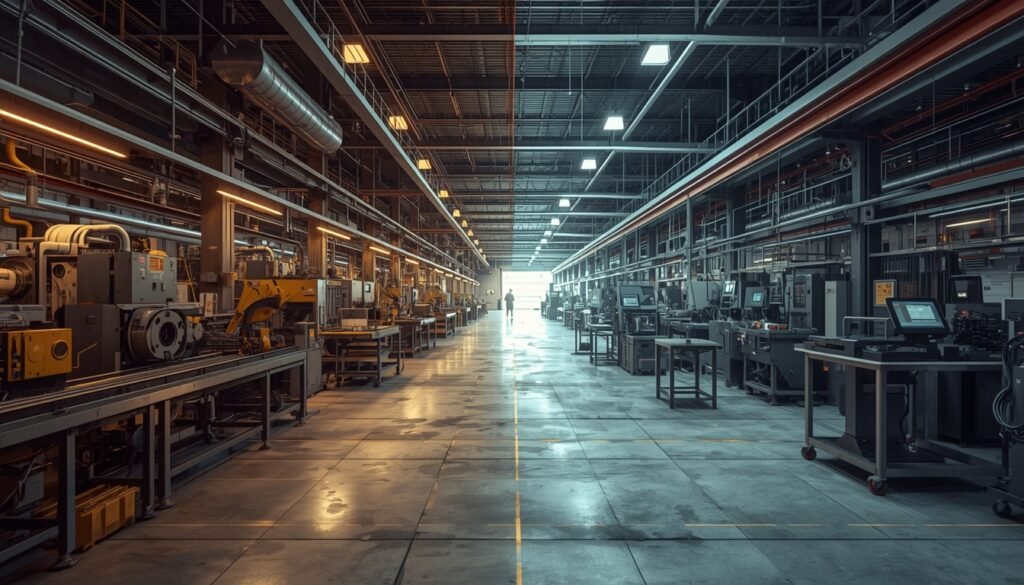
The speed of manufacturing technology adoption is being influenced by the growing amount of operational data generated inside factories.
Machines, sensors, production systems, quality platforms, maintenance tools, and supply chain applications can generate enormous volumes of information. Historically, much of this information remained isolated or was reviewed only after a production event had occurred.
Modern manufacturing systems are designed to make that information more accessible and actionable.
NIST’s 2026 roadmap for AI and machine learning in smart manufacturing highlights industrial big data analytics, advanced sensing, autonomous systems, digital twins, robotics, supply chain optimization, sustainable manufacturing, generative AI, explainable AI, and foundation models as important areas shaping the evolution of smart manufacturing.
This means the factory of the future is not being shaped by one technology. It is being shaped by the convergence of several technologies.
1. Artificial Intelligence Is Moving Deeper Into Manufacturing
Artificial intelligence is one of the most important manufacturing technology trends because it can help manufacturers analyze complex operational information and support decisions across the production environment.
AI in manufacturing can be used for maintenance, quality inspection, production planning, demand forecasting, anomaly detection, process optimization and operational decision support.
Machine learning systems can identify patterns in historical and real-time production data. When connected to machine sensors, AI can identify unusual equipment behavior. When combined with quality data, it can help identify patterns associated with defects. When integrated with production planning, it can help manufacturers evaluate scheduling and capacity decisions.
NIST notes that AI is increasingly being used across manufacturing to improve efficiency, quality, decision-making and visibility although challenges such as data quality, workforce readiness, cybersecurity and legacy-system integration remain.
The next stage is moving beyond isolated AI applications toward AI-enabled manufacturing systems that can support multiple connected processes.
2. Industrial IoT Is Creating More Connected Factories
Industrial Internet of Things technology is another major driver of modern factory transformation.
IIoT allows machines, sensors, equipment, and industrial systems to collect and exchange information. Instead of relying entirely on manual readings or periodic inspections, manufacturers can monitor equipment conditions continuously.
This creates greater visibility into production performance.
For example connected sensors can track vibration, temperature, pressure, machine speed, energy consumption and operating cycles. When this information is connected to analytics platforms manufacturers can identify conditions and investigate them before they result in major production problems.
The real value of IIoT is therefore not simply connectivity. It is the ability to turn equipment data into useful operational information.
- Industrial Robotics Is Becoming More Intelligent
Industrial robotics have been used in manufacturing for many years mainly for tasks that repeat the same action many times or need great exactness.. Industrial robotics is now becoming more flexible because robots are being linked with AI, machine vision, sensors and manufacturing software.
Modern industrial robotics can help with assembly moving materials, welding, packaging, checking quality, loading machines and many other tasks.
The rise of AI is also changing what people expect from industrial robotics. Deloitte says that physical AI is a mix of AI and physical systems and it sees robotics as a key test bed for this technology.
Instead of programming robots only for fixed repetitive actions, manufacturers are increasingly exploring systems that can perceive their environment, respond to changing conditions, and work alongside human employees.
How Robotics Is Changing Factory Operations
| Manufacturing Area | Traditional Approach | Technology-Driven Approach |
|---|---|---|
| Assembly | Manual or fixed automation | Adaptive robotic systems |
| Inspection | Manual inspection | Machine vision and robotics |
| Material handling | Manual movement | Automated guided systems |
| Packaging | Repetitive manual work | Automated robotic packaging |
| Machine tending | Operator-dependent | Robotic machine loading |
| Quality control | Sampling | Continuous automated inspection |
This does not mean that industrial robotics will simply replace manufacturing workers. In places industrial robotics is used to take over repetitive physically demanding or dangerous tasks while employees focus on supervising, fixing problems making quality decisions and doing higher-value work.
4. Digital Twins Are Improving Production Decisions
Digital twins are becoming an important tool for manufacturers who want to understand and improve complex production environments.
A digital twin makes a copy of a physical asset, machine, process or production environment. Digital twins can mix real‑world data with simulation and analytical models.
Manufacturers can use digital twins to examine production processes, test changes, monitor equipment, and understand potential outcomes before making changes to physical operations.
For example, a manufacturer could simulate a change in production parameters before applying it to an actual production line.
Research published in 2026 also highlights the growing role of digital twins in robotics and manufacturing systems, particularly for creating more adaptive and intelligent industrial environments.
The broader value of digital twins is that they can connect design, production, maintenance, and lifecycle information.
5. Edge Computing Is Bringing Faster Intelligence to the Factory Floor
Cloud computing has transformed how businesses store and process information, but manufacturing environments often require extremely fast responses.
This is where industrial edge computing becomes valuable.
Edge computing processes data closer to the machines and equipment generating it. This can reduce latency and support applications where immediate response matters.
Consider a machine producing thousands of units per hour. If a sensor identifies an abnormal condition, the system may need to react quickly. Processing that information close to the production environment can support faster responses than sending every data point to a distant cloud environment first.
Edge computing can therefore complement cloud manufacturing rather than replace it.
Cloud platforms can offer storage, analytics, application management and company‑wide visibility while edge systems can handle local processing and real‑time operational needs.
6. Smart Sensors Are Improving Machine Visibility
Sensors are becoming more capable and more important as factories become connected.
Advanced sensors can monitor machine conditions, environmental variables, production parameters, energy consumption, and product characteristics.
The increasing availability of sensor data supports applications such as predictive maintenance, automated quality inspection, energy management, and process optimization.
However, sensor deployment should be based on a clear operational objective. Installing sensors everywhere without understanding how the resulting information will be used can create unnecessary complexity.
The strongest manufacturing technology strategies connect sensor investments directly to measurable production outcomes.
7. Predictive Maintenance Is Replacing Reactive Approaches
Machine downtime remains one of the biggest operational concerns for manufacturers.
Traditional reactive maintenance waits until equipment fails. Preventive maintenance performs service according to predetermined schedules. Predictive maintenance takes a more data-driven approach by using equipment conditions and historical information to identify potential failures.
Connected machines can continuously generate information about vibration, temperature, pressure, operating cycles, and other variables. Analytics can then identify patterns associated with equipment deterioration.
This allows maintenance teams to investigate potential problems earlier and plan maintenance activities around production requirements.
Maintenance Technology Comparison
| Maintenance Approach | How It Works | Main Limitation |
|---|---|---|
| Reactive maintenance | Repair after failure | Unexpected downtime |
| Preventive maintenance | Service on fixed schedules | May cause unnecessary maintenance |
| Condition-based maintenance | Service based on equipment condition | Requires reliable monitoring |
| Predictive maintenance | Predict potential failures | Requires quality data and analytics |
| Prescriptive maintenance | Recommends or supports actions | Requires advanced analytics and integration |
The evolution from predictive toward prescriptive maintenance is particularly important because future systems may not simply identify that a machine is likely to fail. They may also help recommend what should happen next.
8. Cloud Manufacturing Is Connecting Distributed Operations
Cloud technology is allowing manufacturers to manage information across plants, production lines, and business functions more efficiently.
Instead of keeping information within isolated factory systems, cloud platforms can support centralized access to operational data, analytics, applications, and reporting.
This becomes especially useful for manufacturers operating multiple facilities.
A centralized technology architecture can help leadership compare performance across plants, identify common production issues, and share successful processes.
However cloud adoption does not mean that every manufacturing workload should be moved away from the factory floor.
9. Manufacturing Data Platforms Are Becoming Strategic Infrastructure
Data has become one of the most valuable assets in modern manufacturing, but disconnected data remains a major challenge.
Manufacturers often operate equipment from different vendors, legacy systems, production software, quality platforms, maintenance applications, and enterprise systems.
If these systems cannot communicate effectively, manufacturers may struggle to create a complete picture of production performance.
KPMG’s 2026 industrial manufacturing technology report emphasizes interoperability and resilient data environments as manufacturers move from isolated digital pilots toward enterprise-wide platforms supporting AI, digital twins, and edge computing.
This makes production records integration a strategic problem in preference to certainly an IT subject.
Manufacturing Data Challenges and Solutions
| Data Challenge | Operational Problem | Technology Response |
|---|---|---|
| Data silos | Limited visibility | Integrated data platforms |
| Legacy systems | Difficult connectivity | Modern integration layers |
| Inconsistent formats | Poor analytics | Data standardization |
| Poor data quality | Unreliable insights | Data governance |
| Delayed information | Slow decisions | Real-time pipelines |
| Limited interoperability | Disconnected operations | Open interfaces and standards |
10. Generative AI and Agentic AI Are Entering Manufacturing
Generative AI is expanding beyond traditional business applications and beginning to find manufacturing use cases.
Manufacturers can potentially use generative AI to assist with technical documentation, knowledge management, troubleshooting, training, engineering workflows, and information retrieval.
Agentic AI represents a further development. Instead of simply responding to a prompt, an AI agent can potentially reason through a task, plan actions, interact with systems, and execute workflows under appropriate controls.
Deloitte’s 2026 manufacturing outlook identifies agentic AI as an emerging capability that could enhance smart manufacturing and operations.
However, manufacturing environments require strong reliability and safety controls. AI systems operating around physical equipment need appropriate governance, human oversight, cybersecurity, validation, and clearly defined boundaries.
The goal should not be to introduce AI simply because it is fashionable. Manufacturers should focus on applications where intelligent systems can solve a real operational problem.
11. Additive Manufacturing Is Expanding Production Flexibility
Additive manufacturing, commonly known as 3D printing, continues to evolve from a prototyping technology toward applications in production and industrial supply chains.
It can allow manufacturers to create complex geometries, customized components, lightweight structures, prototypes, tooling, and selected end-use parts.
One important advantage is design flexibility. Traditional manufacturing methods can impose constraints based on machining, molding, tooling, or assembly. Additive manufacturing can provide additional design freedom in suitable applications.
NIST’s 2026 smart manufacturing roadmap includes additive and laser-based manufacturing among areas where AI and advanced technologies are contributing to future industrial capabilities.
12. Connected Worker Technology Is Modernizing Human Operations
Technology transformation is not limited to machines.
Connected worker platforms can provide employees with digital instructions, production information, maintenance guidance, safety information, and real-time operational data.
Wearable devices, mobile interfaces, augmented reality tools, digital work instructions, and industrial communication systems can help employees access information while working on the factory floor.
This can be particularly valuable when experienced workers are retiring and manufacturers need better ways to capture and share operational knowledge.
Rather than replacing human expertise, connected worker technology can help make that expertise easier to access and transfer.
Business Benefits of Modern Manufacturing Technology
The purpose of adopting new technology is ultimately to improve manufacturing performance.
Manufacturers can use technology to improve productivity, increase equipment availability, strengthen quality, reduce waste, improve decision-making, and create more flexible operations.
Manufacturing Technology Benefits
| Business Goal | Relevant Technologies | Expected Impact |
|---|---|---|
| Improve productivity | Automation, robotics, AI | Higher production efficiency |
| Reduce downtime | IIoT, predictive maintenance | Better equipment availability |
| Improve quality | Machine vision, AI analytics | Earlier defect detection |
| Increase visibility | IIoT, cloud platforms | Better operational decisions |
| Reduce waste | Analytics, automation | More efficient resource use |
| Improve flexibility | Robotics, digital twins | Faster production changes |
| Strengthen resilience | Connected systems, analytics | Faster response to disruption |
| Support sustainability | Sensors, energy analytics | Better resource management |
The most important point is that technology should be connected to measurable business outcomes. A manufacturer does not become technologically advanced simply because it has installed sensors, robots, or AI software.
The technology must improve something that matters.
Challenges of Adopting New Manufacturing Technology
Despite the opportunities, manufacturers face several challenges when implementing modern technology.
Legacy equipment is one of the biggest obstacles. Many factories contain machines that have operated successfully for decades but were not designed for digital connectivity.
Cybersecurity is another major consideration. As more machines and systems become connected, the attack surface of operational technology environments expands.
Data quality can also limit the effectiveness of AI and analytics. An advanced algorithm cannot compensate for incomplete, inconsistent, or inaccurate operational data.
Workforce readiness is equally important. New manufacturing technologies require employees who understand both industrial processes and digital systems.
Key Implementation Challenges
| Challenge | Why It Matters |
|---|---|
| Legacy equipment | Makes integration more difficult |
| Cybersecurity | Connected systems increase exposure |
| Data quality | Poor data reduces analytical accuracy |
| Workforce skills | New technology requires new capabilities |
| Integration | Multiple systems must work together |
| Cost | Transformation requires investment |
| Scalability | Successful pilots must work across operations |
These challenges explain why manufacturers should approach digital transformation as a long-term operational strategy rather than a collection of short-term technology projects.

How Manufacturers Can Adopt New Technology Successfully
A successful technology strategy begins with the manufacturing problem rather than the technology.
Instead of asking, “Where can we use AI?” manufacturers should ask, “Where are we losing productivity, quality, time, or capacity?”
This shift creates a more practical approach.
For example, if unexpected equipment failures are creating downtime, predictive maintenance may be the appropriate technology. If quality inspection is inconsistent, machine vision may provide value. If managers lack real-time visibility, IIoT and manufacturing data platforms may be a better priority.
Manufacturers should begin with measurable use cases, establish a baseline, implement the technology, measure the result, and then scale successful solutions.
Practical Technology Adoption Framework
| Step | Focus | Key Question |
|---|---|---|
| 1 | Identify problem | What is limiting performance? |
| 2 | Measure baseline | How large is the problem? |
| 3 | Select technology | Which solution addresses it? |
| 4 | Run pilot | Can the solution deliver measurable value? |
| 5 | Integrate | Can it connect with existing systems? |
| 6 | Scale | Can the solution work across more operations? |
This approach also reduces the risk of investing heavily in technology without achieving measurable results.
What Is the Future of Manufacturing Technology?
The next stage of manufacturing technology will likely be defined by convergence.
AI will work with robotics. Robotics will work with machine vision. IIoT will provide operational data. Edge computing will process information close to equipment. Digital twins will simulate processes. Cloud platforms will connect information across plants. Human workers will interact with increasingly intelligent systems.
This convergence could create factories that are more adaptive than today’s automated production environments.
The shift toward physical AI is particularly interesting because it connects intelligence with physical machines. Deloitte’s 2026 research suggests that physical AI is moving from experimentation toward broader industrial deployment, with robotics serving as an important area for adoption.
At the same time, manufacturers will need to keep people at the center of transformation. Technology can automate repetitive tasks and improve decision support, but manufacturing still depends on engineering judgment, problem-solving, creativity, collaboration, and practical experience.
Conclusion
The latest manufacturing technology trends show that modern factories are moving beyond isolated automation toward connected, intelligent, and increasingly adaptive operations.
Artificial intelligence, Industrial IoT, robotics, digital twins, edge computing, cloud manufacturing, predictive maintenance, additive manufacturing, smart sensors, and connected worker technologies are changing how manufacturers approach production.
The most significant shift is not the adoption of any individual technology. It is the growing ability to connect technologies and use operational data across the manufacturing environment.
For manufacturers, the opportunity is substantial. Connected technology can improve production visibility, reduce downtime, support better quality, increase flexibility, and strengthen operational resilience. But achieving these benefits requires reliable data, strong integration, cybersecurity, workforce development, and a clear focus on business outcomes.
The factories that gain the greatest advantage will not necessarily be those that adopt every new technology first. They will be the manufacturers that identify the right operational problems, select the right technologies, integrate them effectively, and continuously measure the results.
As manufacturing continues to evolve, technology will become less of a separate function and more deeply embedded in the way factories operate. The result will be a new generation of smart manufacturing operations where machines, data, software, and people work together to create faster, more flexible, and more resilient production environments.
Frequently Asked Questions
1. What are the latest manufacturing technology trends?
The latest manufacturing technology trends include artificial intelligence, Industrial IoT, industrial robotics, digital twins, edge computing, predictive maintenance, advanced sensors, cloud manufacturing, additive manufacturing, and connected worker technologies. These technologies are helping factories improve productivity, quality, visibility, and operational efficiency.
2. How is AI changing manufacturing operations?
AI is helping manufacturers analyze production data, detect equipment abnormalities, improve quality inspection, optimize production planning, predict maintenance requirements, and support faster operational decisions. AI is increasingly being integrated with connected machines and manufacturing systems rather than being used as a standalone technology.
3. What is Industrial IoT in manufacturing?
Industrial IoT connects machines, sensors, equipment, and industrial systems so manufacturers can collect and exchange operational data. This connectivity helps improve machine monitoring, production visibility, predictive maintenance, quality control, and process optimization.
4. How do digital twins benefit manufacturers?
Digital twins create digital representations of physical machines, processes, or production environments. Manufacturers can use them to monitor operations, simulate changes, identify potential issues, and improve production and maintenance decisions without immediately changing the physical environment.
5. Why is predictive maintenance important in manufacturing?
Predictive maintenance uses equipment data and analytics to identify potential machine problems before they cause unexpected failures. It can help manufacturers reduce unplanned downtime, improve equipment availability, and plan maintenance activities more efficiently.
6. What role does robotics play in modern manufacturing?
Robotics can automate repetitive, physically demanding, or high-precision tasks such as assembly, welding, material handling, packaging, inspection, and machine tending. Modern robots are increasingly being combined with sensors, machine vision, AI, and connected manufacturing systems.
7. What is edge computing in manufacturing?
Edge computing processes data closer to the machines and equipment generating it instead of sending all information to a centralized cloud environment. This can reduce latency and support real-time manufacturing applications that require fast responses.

Jimmy Simmons
Jimmy Simmons contributes insights and analysis across banking, financial services, fintech, markets and emerging technology.