
Industrial Robotics in Manufacturing: How Smart Robots Improve Factory Efficiency
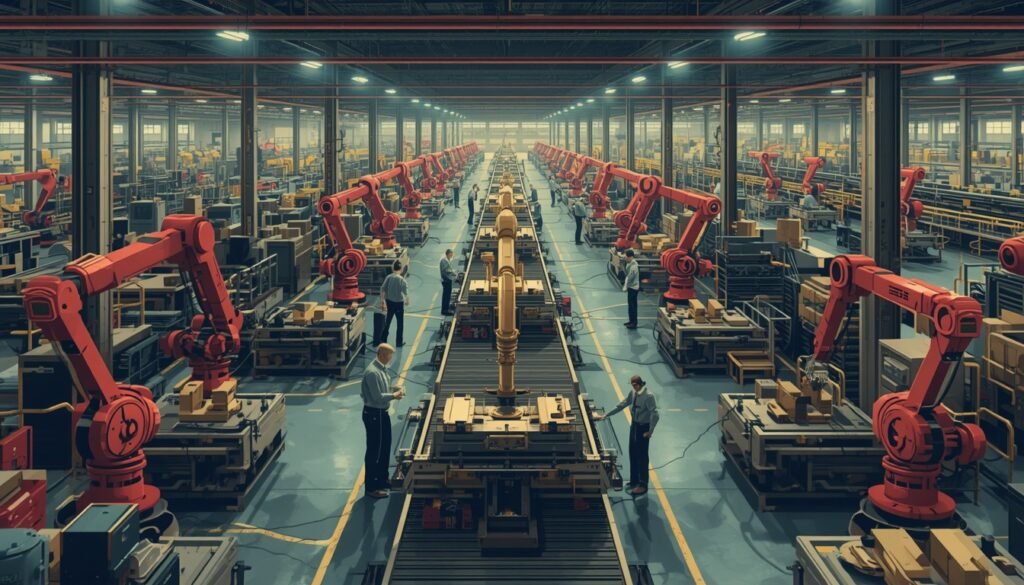
Manufacturing is entering an era where robots are no longer stuck to repetitive moves on isolated production lines. Industrial robotics in manufacturing is becoming more connected, smarter, flexible and more integrated with the overall factory world. Modern industrial robots can work with machine vision, sensors, artificial intelligence, manufacturing software, automated guided systems and real‑time production data to do tasks with consistency while helping manufacturers meet changing production needs. This change is reshaping how factories approach automation, productivity, quality, safety and workforce management.
For years industrial robots have been used for welding, painting, assembly, packaging and material handling. Their main value was simple: to automate tasks and keep production steady. Today the manufacturing world needs more than simple repetition. Manufacturers must deal with labor shortages, higher operating costs, strict quality rules, short production runs, custom products and growing supply chain complexity. Therefore the role of robotics is shifting from task automation to connected and smart production.
The latest generation of smart robots in manufacturing can collect information from their surroundings, communicate with other machines, use vision systems to identify objects, and adapt certain operations based on production conditions. Robotics is also increasingly being combined with artificial intelligence and physical AI. Deloitte’s 2026 manufacturing research describes physical AI as an emerging combination of AI and physical systems, with industrial robotics representing an important area where intelligent systems can interact directly with the physical world.
This does not mean that robots are simply replacing people. In many factories, the more practical opportunity is to allow robots to handle repetitive, hazardous, physically demanding, or highly precise activities while workers focus on supervision, engineering, troubleshooting, quality decisions, and other tasks that require human judgment.
As manufacturing moves, toward Industry 4.0 and smart factory operations robotics is one piece of a larger technology network. The factories that get the value from automation are linking robots with sensors, data platforms, production systems and human workers instead of treating robots as separate machines.
What Is Industrial Robotics in Manufacturing?
Industrial robotics in manufacturing means using robotic machines that work on production tasks with very fast speed, precise control, consistent results and repeatable actions.
Industrial robotics can be made for different settings and uses. Some industrial robots are articulated ones that weld or help build cars. Others are collaborative robots that work close to people.
Modern industrial robotics can do tasks: assembly, welding, painting, machine tending, packaging, palletizing, moving material, inspecting, sorting and placing parts.
The biggest change today is connectivity. An industrial robot can now join a manufacturing system instead of standing alone as a separate machine.
Major Types of Industrial Robots
| Robot Type | Common Manufacturing Applications | Main Advantage |
|---|---|---|
| Articulated robots | Welding, assembly, handling | Flexible movement |
| SCARA robots | Assembly, pick-and-place | High-speed precision |
| Delta robots | Packaging, sorting | Very fast movement |
| Cartesian robots | Material handling, machining | Accurate linear movement |
| Collaborative robots | Assembly, inspection, machine tending | Human-robot collaboration |
| Autonomous mobile robots | Material movement | Flexible factory logistics |
Choosing the right robot relies upon on factors consisting of payload, reach, velocity, accuracy, workspace, production volume, protection necessities, and the type of task being computerized.

Why Industrial Robotics Is Becoming More Important
The growth of industrial robotics is closely connected to the broader transformation of manufacturing.
Factories are under pressure to make products while keeping costs low and maintaining high quality. At the time many jobs in manufacturing are repetitive and physically demanding. Its getting harder for companies to find workers with the skills.
Robotics helps solve these problems by doing tasks that must be repeated over and over with consistency and precision.
Another important factor is product customization. Traditional automation often worked best when manufacturers produced large quantities of identical products. Modern robotics, particularly when combined with machine vision and bendy programming, can aid extra numerous manufacturing environments.
This flexibility is increasingly important as manufacturers move toward shorter production runs and more customized products.
How Smart Robots Are Different From Traditional Industrial Robots
Traditional industrial robots are often programmed to perform a fixed sequence of actions under controlled conditions.
Smart robots are increasingly connected to sensors, cameras, production systems, and data platforms. This allows them to obtain information about their environment and use that information during operations.
For example a traditional robot might pick up a part from a location. A smart robot using machine vision can see the part figure out where it is, what direction it’s facing and even check its condition adjust its movement accordingly.
This may seem like a change but it makes a big difference. It opens up more uses for robotics, in real-world production settings.
Traditional Robots vs. Smart Robots
| Capability | Traditional Industrial Robot | Smart Robotic System |
|---|---|---|
| Programming | Fixed sequences | More adaptive programming |
| Environment | Highly controlled | Can respond to changing conditions |
| Vision | Often separate system | Increasingly integrated |
| Data | Limited operational data | Continuous data generation |
| Connectivity | Standalone or limited | Connected to factory systems |
| Analytics | Limited | Increasingly data-driven |
| Adaptability | Lower | Higher |
| Collaboration | Usually isolated | Can support human-robot workflows |
The future of robotic automation in factories is therefore moving toward systems that can perceive, analyze, and respond rather than simply repeat.
1. Robotics Is Improving Production Speed
One of the most direct benefits of industrial robotics is increased production speed.
Robots can perform movements continuously and maintain consistent cycle times. They do not experience fatigue in the way human workers do allowing them to perform suitable tasks over extended production periods.
This can be particularly valuable in high-volume manufacturing environments where even small improvements in cycle time can have a significant impact on total output.
However, simply installing a robot does not guarantee higher productivity. The complete production process needs to be considered.
A fast robot connected to a slow material-handling process may not improve overall throughput. Manufacturers therefore need to examine the entire production workflow when implementing robotic automation.
2. Robots Are Improving Manufacturing Quality
Consistency is another major advantage of industrial robotics.
Human workers can perform highly accurate tasks, but repetitive operations can become difficult when they need to be performed thousands of times with exactly the same movement and force.
Robots can maintain programmed movements and parameters with a high degree of repeatability.
This can help manufacturers reduce variation in applications such, as welding, adhesive application, assembly, painting, dispensing and component placement.
When robotics is combined with machine vision the system can also inspect components and products during production.
Manufacturing Applications of Robotics
| Application | What Robots Do | Potential Benefit |
|---|---|---|
| Assembly | Position and join components | Consistent assembly |
| Welding | Perform programmed welds | Repeatable quality |
| Painting | Apply coatings | Consistent coverage |
| Packaging | Pack and arrange products | Higher throughput |
| Palletizing | Stack finished products | Reduced manual handling |
| Inspection | Identify defects | Faster quality checks |
| Machine tending | Load and unload machines | Improved machine utilization |
3. Machine Vision Is Making Robots More Intelligent
Machine vision is becoming an important technology for modern robotic manufacturing.
Instead of depending totally on constant positions, robotic systems can use cameras and computer vision to understand items and their places.
A vision-enabled robot may identify a component on a conveyor, determine its orientation, and select the correct movement.
Machine vision can also support quality inspection. Cameras can examine products for scratches, missing components, incorrect assembly, surface defects, or dimensional differences.
When combined with AI, vision systems can become more capable of recognizing complex patterns.
This creates an important connection between industrial robotics and AI in manufacturing.
The robot provides physical action, while AI and vision can provide perception and decision support.
4. Collaborative Robots Are Changing Human-Robot Interaction
Collaborative robots often called cobots are designed to operate in environments where humans and robots can work together subject to appropriate risk assessment and safety measures. I think cobots make work safer.
Traditional industrial robots are often separated from workers using physical barriers because they can move at high speed and carry heavy loads.
Cobots can be useful for applications where humans and machines have complementary strengths.
For example, a robot may handle repetitive component placement while a worker performs inspection or final assembly.
The fee of collaborative robotics is therefore not clearly automation. It is the capacity to mix robotic consistency with human judgment.
Human-Robot Collaboration
| Human Strength | Robot Strength | Combined Opportunity |
|---|---|---|
| Judgment | Repeatability | Consistent production with human oversight |
| Problem-solving | Speed | Faster repetitive workflows |
| Flexibility | Precision | Flexible precision tasks |
| Quality decisions | Continuous operation | Faster inspection workflows |
| Process knowledge | Physical handling | More efficient machine operation |
However, collaborative robots should not be treated as automatically safe simply because they are labeled collaborative. Manufacturers still need appropriate safety assessments, controls, training, and application-specific risk management.
5. Robotics Is Supporting Flexible Manufacturing
Manufacturing is becoming more flexible as companies respond to customized products, shorter product lifecycles, and changing customer demand.
Older automation systems often required significant reconfiguration when production requirements changed.
Modern robots can provide greater flexibility through software-based programming, interchangeable tooling, machine vision, and connected manufacturing systems.
This allows manufacturers to adjust production processes without necessarily rebuilding entire production lines.
For manufacturers producing multiple product variations, this flexibility can become a significant competitive advantage.

6. Robotics Is Improving Factory Safety
Industrial robotics can also reduce exposure to dangerous working conditions.
Some manufacturing tasks involve high temperatures, hazardous chemicals, heavy loads, sharp materials, repetitive physical movements, or other risks.
Robots can perform suitable tasks in environments where human exposure should be minimized.
Examples include handling hot components, welding, painting, heavy material movement, and certain inspection operations.
The goal is not to remove people from the manufacturing environment. Instead, robotics can help move people away from the most hazardous or physically demanding activities.
7. Robotics and Predictive Maintenance Are Becoming Connected
Modern robotic systems can generate operational information about motors, joints, movement cycles, temperatures, error conditions, and other machine parameters.
This data can support predictive maintenance strategies.
Instead of waiting for a robotic component to fail, maintenance teams can monitor equipment conditions and identify unusual behavior.
For example, repeated changes in motor performance or abnormal vibration may indicate a developing issue.
When robotics data is connected to a broader predictive maintenance system, manufacturers can improve maintenance planning and potentially reduce unexpected production interruptions.
Robotics Data for Maintenance
| Data Point | What It Can Indicate |
|---|---|
| Motor temperature | Potential overheating |
| Vibration | Mechanical abnormalities |
| Cycle time | Changes in performance |
| Error codes | Equipment issues |
| Operating hours | Maintenance requirements |
| Joint movement | Mechanical wear |
| Energy consumption | Changes in equipment behavior |
The effectiveness of predictive maintenance depends on data quality and the ability to connect equipment information with appropriate analytics and maintenance workflows.
8. Smart Robots Are Becoming Part of Connected Factories
A modern robot should not necessarily be viewed as an isolated machine.
It can become part of a larger connected manufacturing environment involving Industrial IoT, manufacturing execution systems, enterprise resource planning platforms, quality management systems, sensors, digital twins, and cloud or edge platforms.
This connectivity allows production information to move across different levels of the organization.
For example, a production system can provide a robot with information about which product should be produced next. The robot can then perform the required operation and send production information back into the manufacturing system.
This creates a more connected production cycle.
9. AI Is Expanding What Robots Can Do
Artificial intelligence is becoming one of the most important technologies influencing the next generation of industrial robotics.
Traditional robotic systems generally depend on predefined instructions. AI can provide additional capabilities such as object recognition, anomaly detection, decision support, path optimization, and adaptive behavior.
The combination of AI and robotics is particularly important because it brings digital intelligence into the physical manufacturing environment.
Deloitte’s 2026 research on physical AI describes a future where intelligent machines can perceive their surroundings, reason about physical environments, and take action. Industrial robotics is one of the major areas where these capabilities can be developed and deployed.
However, AI-enabled robotics must still operate within appropriate safety, reliability, cybersecurity, and human-oversight frameworks.
10. Robotics Is Improving Material Handling and Factory Logistics
Robotics is not limited to production processes.
Factories are increasingly using robotic systems to move materials, components, work-in-progress products, and finished goods.
Autonomous mobile robots can navigate manufacturing environments and transport materials between workstations, storage areas, and production lines.
This can reduce unnecessary manual transportation and allow workers to focus on higher-value activities.
When mobile robotics is integrated with warehouse management and production systems, material movement can become more responsive to real-time production requirements.
Business Benefits of Industrial Robotics
The business case for robotics depends on the application, but several potential benefits can be achieved when automation is properly designed and integrated.
Robotics can increase throughput, improve repeatability, reduce exposure to hazardous work, improve production consistency, and support more flexible operations.
Key Benefits of Manufacturing Robotics
| Business Objective | Robotics Contribution |
|---|---|
| Increase productivity | Faster and consistent task execution |
| Improve quality | Repeatable production movements |
| Reduce downtime | Automated and monitored operations |
| Improve safety | Reduced exposure to hazardous tasks |
| Reduce repetitive work | Automates physically demanding activities |
| Increase flexibility | Programmable production processes |
| Improve utilization | Supports extended operating periods |
| Increase visibility | Generates operational data |
The return on investment depends on factors such as production volume, labor costs, robot utilization, integration complexity, maintenance requirements, and the specific task being automated.
Challenges of Implementing Industrial Robotics
Although robotics offers significant advantages, implementation can create challenges.
The initial investment is one consideration. Manufacturers may need to invest not only in the robot itself but also in tooling, safety systems, programming, integration, sensors, machine vision, infrastructure, and employee training.
Integration can also be difficult in factories with legacy equipment.
A robot may work effectively on its own but deliver limited value if it cannot communicate with upstream and downstream systems.
Workforce readiness is another important factor. Employees need training to operate, program, maintain, troubleshoot, and supervise robotic systems.
Cybersecurity is also increasingly important as robots become connected to factory networks.
Common Robotics Implementation Challenges
| Challenge | Potential Impact |
|---|---|
| High initial investment | Longer payback period |
| System integration | Delays deployment |
| Legacy equipment | Connectivity limitations |
| Skills shortage | Difficult operation and maintenance |
| Safety requirements | Additional engineering needs |
| Cybersecurity | Increased connected-system exposure |
| Poor process design | Limited automation benefits |
| Maintenance | Requires ongoing technical support |
Manufacturers should therefore evaluate the entire automation environment rather than looking only at the purchase price of a robot.
How to Choose the Right Industrial Robot
Choosing a robot begins with understanding the task.
Manufacturers should evaluate the required payload, reach, speed, precision, cycle time, workspace, environmental conditions, tooling requirements, safety requirements, and expected production volume.
The robot should be selected based on the process rather than the other way around.
For example, a lightweight collaborative robot may be appropriate for certain assembly tasks but unsuitable for heavy material handling.
Similarly, a high-speed delta robot may be highly effective for packaging but unnecessary for a slower assembly process.
The objective is to match the robotic system with the operational requirement.
How Manufacturers Can Start With Robotic Automation
Manufacturers do not need to automate an entire factory at once.
A better approach is often to identify a repetitive or problematic process that has clear performance measurements.
A good initial application might involve repetitive handling, machine loading, packaging, inspection, or another process where productivity and quality can be measured before and after automation.
Once the first application produces measurable results, manufacturers can evaluate whether the same approach can be expanded to other production areas.
Practical Robotics Adoption Roadmap
| Stage | Focus | Key Activity |
|---|---|---|
| 1 | Identify | Find a suitable automation opportunity |
| 2 | Evaluate | Measure current productivity and costs |
| 3 | Design | Select robot, tooling, sensors and safety systems |
| 4 | Pilot | Test the robotic application |
| 5 | Measure | Compare results against baseline |
| 6 | Optimize | Improve programming and workflow |
| 7 | Scale | Expand successful automation |
This approach can reduce risk and provide management with measurable evidence before larger investments are made.
What Is the Future of Industrial Robotics?
The future of industrial robotics in manufacturing will likely involve greater integration between robots, AI, machine vision, sensors, digital twins, edge computing, and manufacturing software.
Robots are expected to become more capable of understanding their environments and responding to changes.
The concept of physical AI could accelerate this transition by combining AI-based perception and reasoning with machines that can physically interact with the world.
At the same time, human-robot collaboration will remain important. Manufacturing environments are complex, and many tasks require judgment, creativity, problem-solving, and process knowledge.
The future factory is therefore unlikely to be completely human or completely robotic. Instead, it will increasingly involve collaboration between people and intelligent machines.
Conclusion
Industrial robotics in manufacturing is evolving from simple task automation toward connected, intelligent, and increasingly flexible production systems.
Modern robots can perform repetitive operations with speed and consistency, while machine vision, sensors, AI, and connected software are giving robotic systems greater awareness and adaptability.
Manufacturers can use robotics to improve production efficiency, quality, safety, material handling, machine utilization, and operational consistency. When robotic systems are integrated with IIoT, predictive maintenance, manufacturing software, and data platforms, they can become an important part of the connected factory.
However, successful robotic automation requires more than purchasing a robot. Manufacturers need to identify the right use cases, evaluate the complete production workflow, address safety and cybersecurity, prepare their workforce, and measure the results.
The most effective approach is to start with a clear manufacturing problem and use robotics to solve it.
As AI, physical intelligence, machine vision, and connected manufacturing continue to develop, industrial robots will become increasingly capable of interacting with complex production environments. The result will be factories that are not only more automated, but also more flexible, data-driven, efficient, and responsive.
For manufacturers looking to modernize operations, robotics is no longer simply a tool for repetitive work. It is becoming a core technology for building the next generation of smart manufacturing.
Frequently Asked Questions
1. What is industrial robotics in manufacturing?
Industrial robotics in manufacturing refers to the use of programmable robotic systems to perform tasks such as assembly, welding, material handling, packaging, inspection, painting, and machine tending. Modern robots can also connect with sensors, machine vision, AI, and manufacturing software.
2. How do industrial robots improve factory efficiency?
Industrial robots can improve factory efficiency by performing repetitive tasks quickly and consistently, reducing process variation, supporting continuous production, improving machine utilization, and helping workers focus on higher-value activities.
3. What are the main types of industrial robots?
Common types include articulated robots, SCARA robots, delta robots, Cartesian robots, collaborative robots, and autonomous mobile robots. Each type is designed for different manufacturing applications, workloads, movement requirements, and production environments.
4. What are smart robots in manufacturing?
Smart robots are connected robotic systems that can use sensors, machine vision, AI, and production data to understand their operating environment and perform tasks with greater flexibility. Unlike traditional robots, smart robots can increasingly interact with other factory systems.
5. How is AI changing industrial robotics?
AI can help robots recognize objects, detect abnormalities, optimize movements, analyze production data, and respond to changing conditions. Combining AI with robotics is also contributing to the development of physical AI for industrial applications.

Jimmy Simmons
Jimmy Simmons contributes insights and analysis across banking, financial services, fintech, markets and emerging technology.